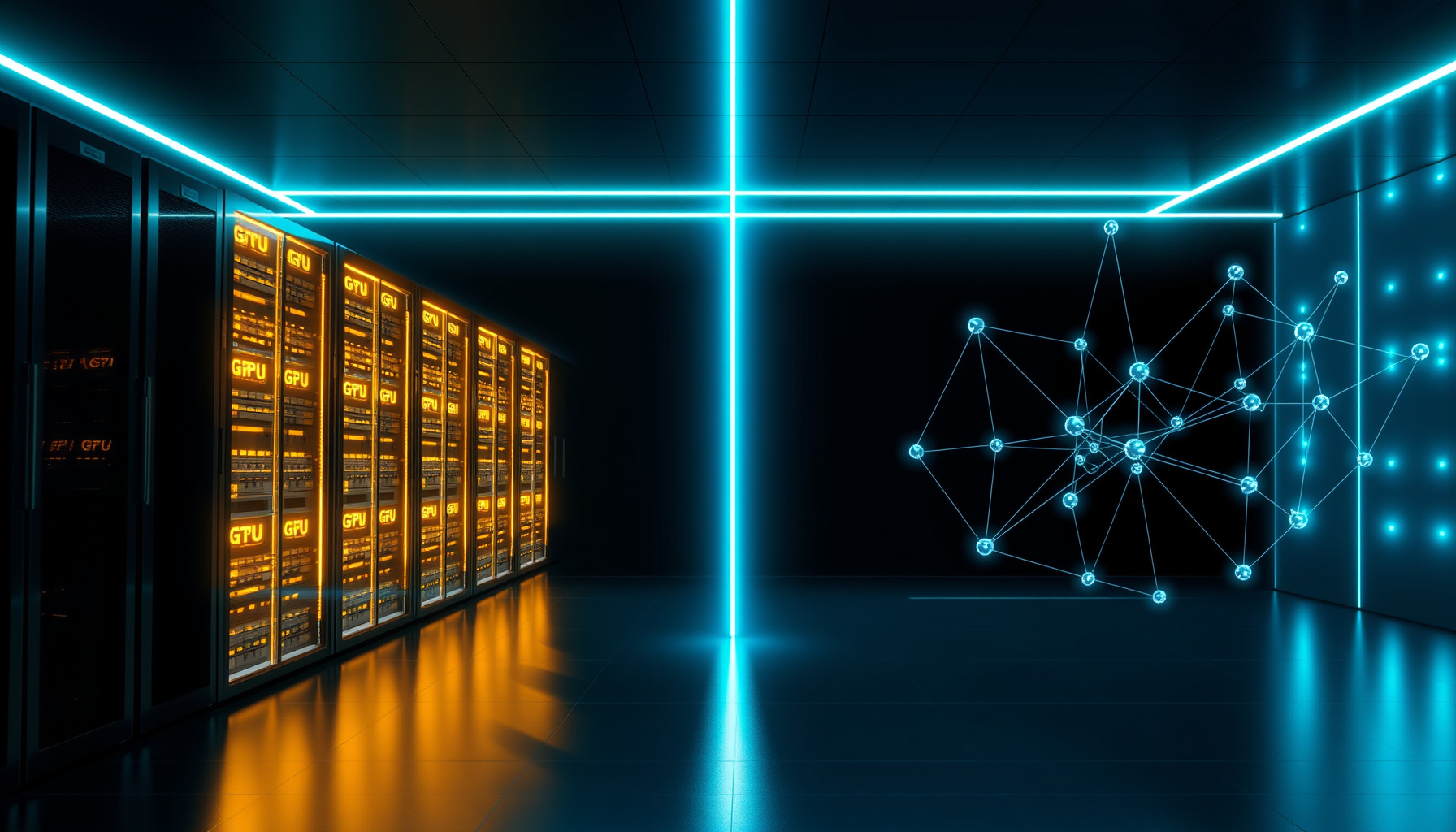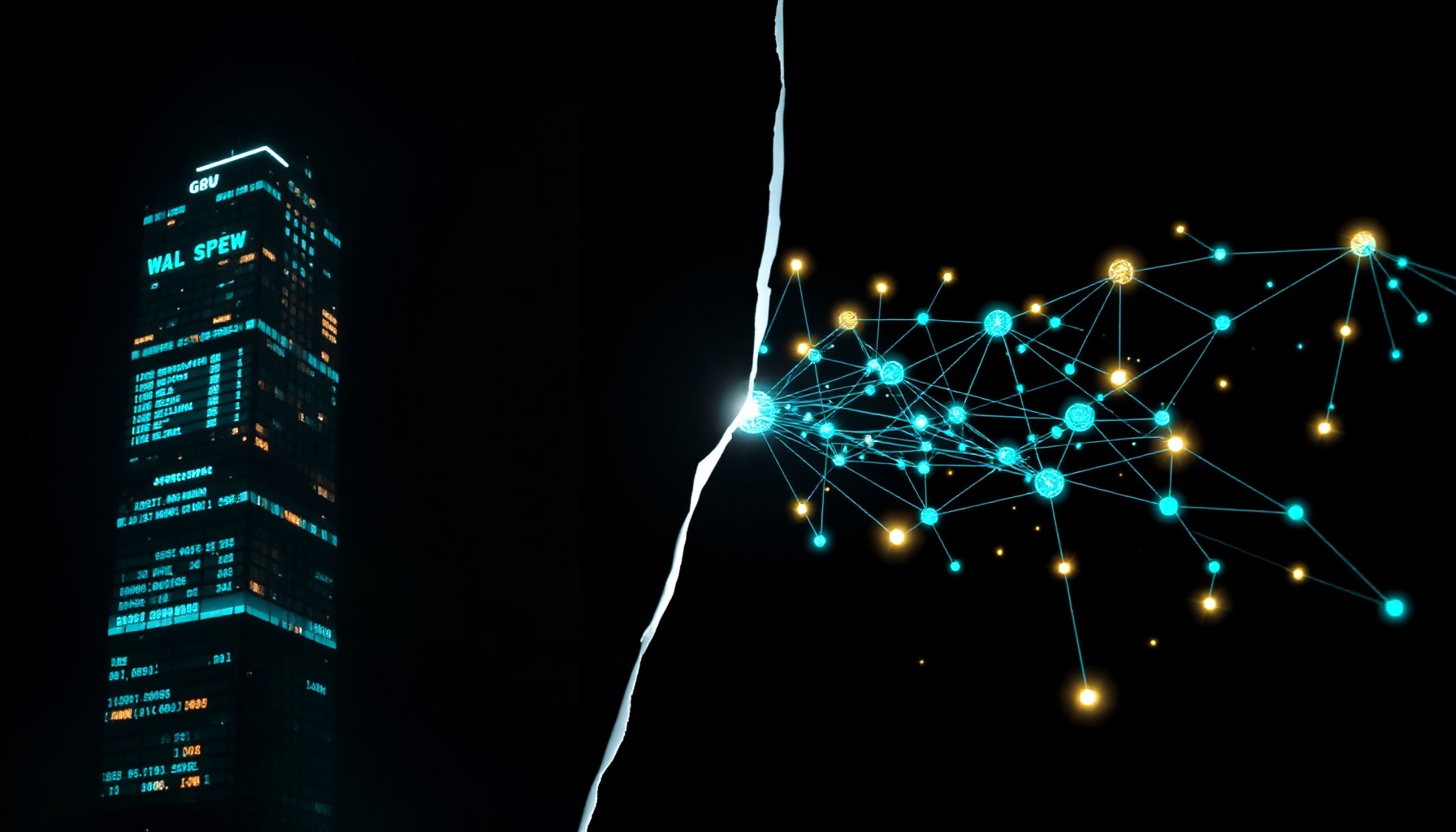
The tectonic plates of AI infrastructure just shifted. On August 10-11, 2026, Nvidia signed memoranda of understanding (MOUs) with Apollo, Blackstone, BlackRock, Brookfield, Goldman Sachs, and KKR to mobilize over $500 billion in third-party capital for AI compute buildout reuters.com. Jensen Huang framed it as a watershed moment: “the first time technology chips have become an investable asset class” reuters.com.
For decentralized AI token holders — particularly TAO, RENDER, and AKT — this isn’t just another macro headline. It’s a direct competitive threat, a valuation reality check, and possibly a catalyst for fundamental redesign. Let’s break down what the Wall Street compute machine means for DePIN networks.
The deal: chips as collateral, not just products
The Nvidia-Wall Street MOUs transform GPU procurement into a structured finance product reuters.com. Instead of hyperscalers and startups buying chips outright, the participating firms will pool capital to fund data centers, with Nvidia providing technology and possibly off-balance-sheet guarantees. The 500B figure is not a single commitment but a mobilization target across multiple funds and special purpose vehicles.
This has immediate implications for hardware supply. If even half of that capital converts to actual GPU orders, we’re looking at a multi-year backlog extension for Blackwell and Rubin architectures. For DePIN networks that rely on consumer and small-data-center GPUs, the secondary market just got thinner and pricier.
The CoinDesk reality check: 1/300th of the throughput
CoinDesk’s analysis, citing Epoch AI data, delivers a sobering stat: DePIN networks currently deliver roughly 1/300th of frontier data-center throughput coindesk.com. The structural blockers are not tokenomics issues — they’re physics and engineering issues:
- Bandwidth: Frontier clusters use NVLink and InfiniBand at 400-800 Gbps per GPU coindesk.com. DePIN nodes typically connect over public internet with 1-10 Gbps uplinks. Synchronous training across thousands of GPUs becomes impossible when the interconnect is three orders of magnitude slower.
- Cryptographic verification overhead: ZK-proofs and optimistic verification add latency and compute overhead. For inference workloads this is tolerable; for training gradients, it’s prohibitive.
- Missing enterprise SLAs: No DePIN network offers 99.99% uptime guarantees with financial penalties. Anthropic, OpenAI, and Google need contractual certainty, not probabilistic availability.
This isn’t a temporary gap — it’s a structural one. Wall Street’s 500B commitment is building the exact infrastructure that DePIN cannot yet replicate.
The Anthropic-Riot deal: a case study in compute desperation
On August 10, Anthropic signed a 9.1 billion dollar, 20-year lease with bitcoin miner Riot Platforms for 191MW at its Rockdale, Texas facility thenextweb.com. RIOT jumped roughly 25% on the news theblock.co. Morgan Stanley is providing 573M in financing.
This is Anthropic’s third compute deal in three weeks. Why? Because they can’t get enough GPUs through traditional channels, and they’re willing to pay a massive premium for power and land that already has grid interconnection.
The lesson for DePIN: even a top-tier AI lab with billions in funding is resorting to bitcoin miners for compute. They are not turning to Bittensor or Akash. The trust gap is not about price — it’s about verifiability, latency, and legal recourse.
Wintermute’s billion-dollar pivot: the market maker sees the writing on the wall
Wintermute, one of crypto’s largest market makers, just committed 1B to HFT and AI data-center infrastructure cryptobriefing.com, targeting more than 50% non-crypto revenue by 2027.
This is a signal from someone who understands token liquidity deeply. Wintermute is not abandoning crypto — they’re hedging it. They see that AI compute demand is more durable and less volatile than crypto trading volumes. If the market makers are diversifying into centralized AI infrastructure, what does that say about the long-term liquidity prospects for DePIN tokens?
Token-level impact: TAO, RENDER, AKT
TAO (Bittensor)
Bittensor’s vision is a decentralized machine intelligence marketplace. Its subnet architecture allows for specialized models, but the underlying hardware is still distributed across consumer GPUs and small data centers. The 1/300th throughput gap means TAO subnets cannot compete for frontier training tasks. However, TAO’s differentiation is in inference routing and model discovery, not raw training. If the network pivots to serving specialized, fine-tuned models on edge hardware, it could coexist with Wall Street’s mega-clusters. The risk is that Nvidia’s capital influx accelerates frontier model commoditization, reducing the demand for niche decentralized models.
RENDER (Render Network)
Render’s focus on GPU-based rendering for 3D, VFX, and AI inference is more aligned with burstable workloads than continuous training. The 500B centralized buildout will saturate the market with high-end rendering capacity at centralized facilities reuters.com. Render’s value proposition is cost arbitrage — but if centralized supply increases dramatically, that arbitrage narrows. The counter-argument: Render’s distributed network offers geographic redundancy and censorship resistance, which some enterprises value. Still, without enterprise SLAs, institutional adoption will remain limited.
AKT (Akash)
Akash is the most direct competitor to centralized cloud providers, offering a marketplace for containerized workloads. Its Supercloud model has attracted some AI inference jobs, but the throughput and latency constraints remain. The Nvidia-Wall Street deal could actually benefit Akash in one way: oversupply of centralized compute in specific regions may lead to price volatility, pushing cost-sensitive workloads to decentralized alternatives. But this is speculative and contingent on Akash closing the SLA gap.
The structural dilemma: can DePIN ever catch up?
Let’s be direct: DePIN networks will not catch up on frontier training throughput in the next 3-5 years. The capital, engineering talent, and supply chain advantages of Wall Street-backed data centers are insurmountable at current trajectory. The 1/300th ratio may even widen.
But that’s not the right frame. The right question is: what workloads are underserved by centralized AI infrastructure?
- Privacy-sensitive inference: Healthcare, finance, legal — where data cannot leave jurisdiction.
- Edge inference: Real-time applications on mobile, IoT, and automotive that cannot tolerate cloud round-trips.
- Censorship-resistant training: Models for regions with restrictive internet governance.
- Long-tail model serving: Thousands of small, specialized models that don’t justify dedicated GPU clusters.
These are all valid niches, but they require DePIN projects to stop pretending they can compete with Nvidia and start building for specific, high-value use cases.
The tokenomic response: what should change?
If advising a DePIN protocol, three immediate actions matter:
- Enterprise-grade SLAs: Implement staking-based insurance pools that compensate users for downtime. This is technically feasible today with existing token infrastructure.
- Hybrid architecture: Allow workloads to burst to centralized clouds when DePIN capacity is insufficient. This sacrifices purity but wins adoption.
- Proof-of-compute with hardware attestation: Use TEEs (Trusted Execution Environments) to provide cryptographic guarantees about the hardware running the workload. This addresses the verification overhead problem.
None of these are easy, but they’re necessary for survival.
Final thoughts: the bifurcation is real
The Nvidia-Wall Street deal creates a clear bifurcation: frontier AI compute will be centralized, institutional, and capital-intensive. Decentralized AI will serve the long tail, the privacy-sensitive, and the geographically constrained.
For TAO, RENDER, and AKT holders, this is not a death knell — but it is a reset of expectations. The “decentralized AI will eat the cloud” narrative is dead. The “decentralized AI will serve the edges” narrative is barely alive.
The next 18 months will determine whether DePIN tokens become niche utilities or fade into irrelevance. The capital is flowing to Nvidia’s partners. The question is whether decentralized networks can find their own capital-efficient niche before the Wall Street machine saturates every compute market.
Sources:
reuters.com https://www.reuters.com/technology/wall-street-giants-partner-with-nvidia-500-billion-ai-financing-deal-ft-reports-2026-08-10/
coindesk.com https://www.coindesk.com/tech/2026/08/11/nvidia-wants-to-turn-its-ai-chips-into-an-investable-asset-class
thenextweb.com https://thenextweb.com/news/anthropic-riot-9bn-data-centre-deal
theblock.co https://www.theblock.co/news/business/2026-08-10-riot-platforms-ai-deal-anthropic-411358
cryptobriefing.com https://cryptobriefing.com/wintermute-1b-hft-ai-infrastructure-investment/
📖 Related Reads
- ToolBrain — tool reviews, LLM comparisons, and AI workflow guides
Cross-links automatically generated from NiteAgent.
← Back to all posts