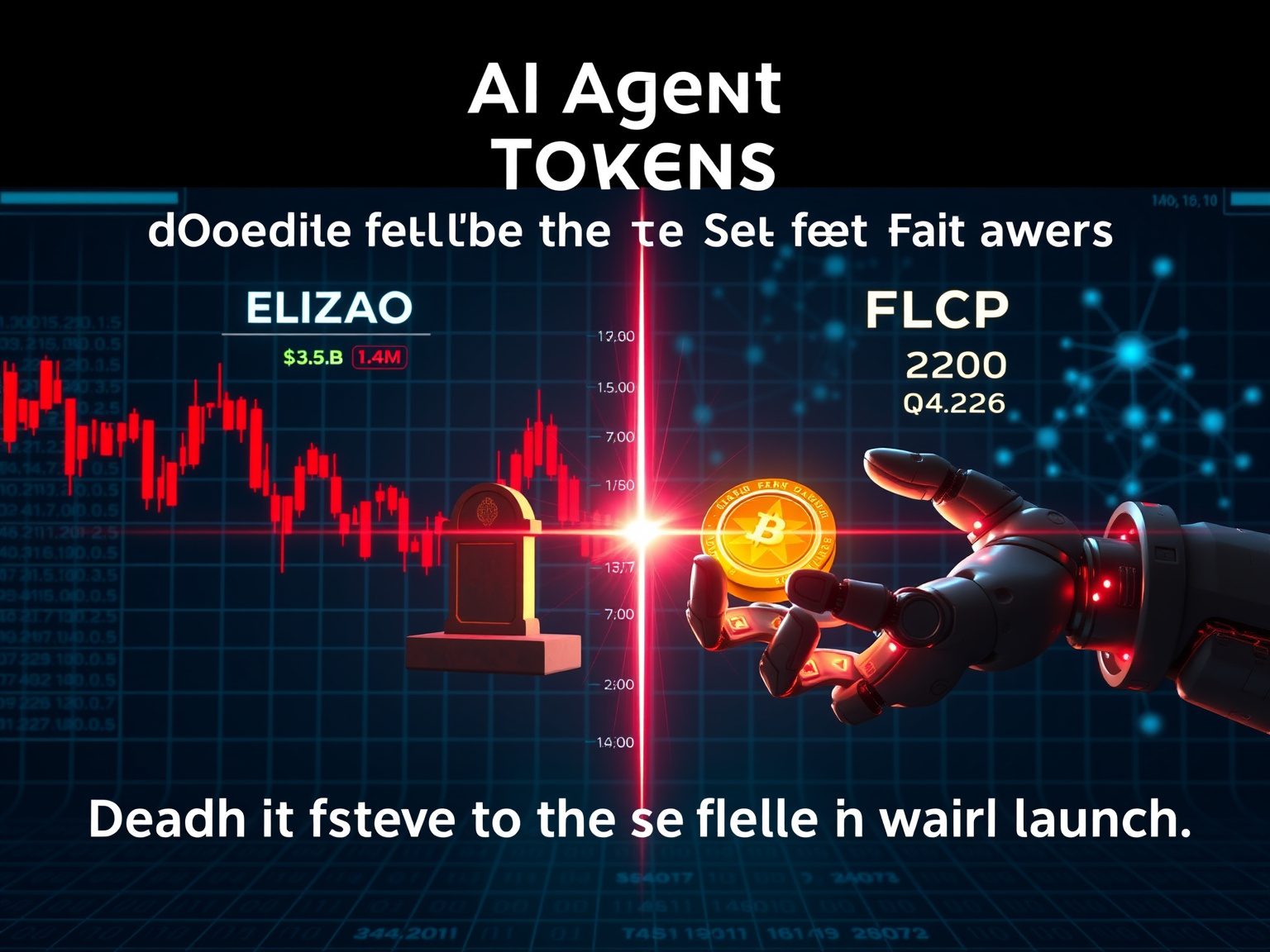
On August 5, 2026, Eliza Labs founder Shaw Walters declared the ELIZAOS token “dead. Completely.” The foundation is winding down. There will be no buybacks, no further supply measures, no foundation support — holders should sell AI agent token AI16Z, once worth $2.4 billion, ends with founder ca…. The token that replaced AI16Z, once worth $2.39 billion at its January 2, 2025 peak, now trades near $0.00031 with a market cap of roughly $2.3 million, down 97% from its post-rebrand high AI agent token AI16Z, once worth $2.4 billion, ends with founder ca….
The detail that matters most: Walters says he will keep building the open-source ElizaOS agent framework — without a new token AI agent token AI16Z, once worth $2.4 billion, ends with founder ca…. The software outlives the token. That single fact is the whole thesis: agent frameworks don’t need tokens, and every project that bolted one on is learning the same lesson at holder expense.
The elizaos collapse: $2.4b to zero in nineteen months
The timeline reads like a designed experiment in how to destroy token value:
- Oct 24, 2024 — ai16z launches on Solana via daos.fun, raising
420.69 SOL ($75,000) [ai16z/ElizaOS Foundation Shuts Down as Token Collapses From $2.6 B…. - Jan 2, 2025 — AI16Z peaks at a $2.39B market cap with $291M in daily volume AI agent token AI16Z, once worth $2.4 billion, ends with founder ca….
- Jan 28, 2025 — Andreessen Horowitz objects to the “ai16z” name; the project is forced to rebrand AI agent token AI16Z, once worth $2.4 billion, ends with founder ca…[ai16z/ElizaOS Foundation Shuts Down as Token Collapses From $2.6 B….
- Sep–Nov 2025 — the migration to ELIZAOS expands total supply tenfold to 11 billion tokens, with 40% of newly minted supply allocated to insider-controlled entities, per the later complaint [ai16z/ElizaOS Foundation Shuts Down as Token Collapses From $2.6 B….
- Apr 22, 2026 — Burwick Law files Doe v. Walters (No. 1:26-cv-03238) in the Southern District of New York, a proposed class action alleging false advertising, deceptive practices, negligent misrepresentation, and unjust enrichment — centered on claims the project marketed itself as an “autonomous, AI-run venture fund” and on dilution during the migration AI agent token AI16Z, once worth $2.4 billion, ends with founder ca…[ai16z/ElizaOS Foundation Shuts Down as Token Collapses From $2.6 B….
- Aug 4, 2026 — Walters announces the token is dead and the foundation is closing; the remaining treasury was transferred to settle the case AI agent token AI16Z, once worth $2.4 billion, ends with founder ca…[ai16z/ElizaOS Foundation Shuts Down as Token Collapses From $2.6 B….
Burwick Law’s materials put class harm in the hundreds of millions across at least 3,945 wallet addresses showing losses [ai16z/ElizaOS Foundation Shuts Down as Token Collapses From $2.6 B…. Walters said the foundation “didn’t have the capital to legally fight” the claim, and that he watched tokens once worth about $25 million fall toward zero without selling AI agent token AI16Z, once worth $2.4 billion, ends with founder ca…. The sequencing matters: ELIZAOS had already fallen roughly 97–98% from its November 2025 high before the lawsuit was even filed [ai16z/ElizaOS Foundation Shuts Down as Token Collapses From $2.6 B…. The legal settlement finished the corpse; the market had already priced the collapse.
The pattern: tokens create perverse incentives
ELIZAOS is not an outlier — it’s the cleanest instance yet of a structural pattern. Token-gated agent frameworks fail on three recurring failure modes:
Migration dilution. The AI16Z→ELIZAOS migration expanded supply 10x and, per the complaint, put 40% of the new supply in insider-controlled hands [ai16z/ElizaOS Foundation Shuts Down as Token Collapses From $2.6 B…. Migration is the moment insiders reprice outsider claims, and it is a feature, not a bug, of founder-controlled tokens: when the narrative sours, the team can always relaunch. The category has done this repeatedly — Truth Terminal’s GOAT token hit $1.2 billion in days and collapsed, Virtuals Protocol enabled agent tokens en masse, and the sector was worth billions in early 2025 with AI16Z and Virtuals accounting for more than half AI agent token AI16Z, once worth $2.4 billion, ends with founder ca…. None of those tokens ever gated a single line of framework code.
Treasury mismanagement. The ai16z daos.fun vehicle held more than $22 million in user-supplied tokens and was due to expire in October 2025 AI agent token AI16Z, once worth $2.4 billion, ends with founder ca…. The settlement then drained what remained. A treasury that a lawsuit can claim — controlled by one founder, with no board, no disclosure, and no holder vote on the settlement — is not a moat. It’s a honeypot. Token holders were equity without rights.
Speculative premium disconnected from utility. ElizaOS adoption never created token demand, because the token never priced the software. Walters’ own post concedes the dynamic: “We built cool shit but it was completely ignored because number down” AI agent token AI16Z, once worth $2.4 billion, ends with founder ca…. When the narrative broke, there was no utility floor — framework usage, downloads, and agent deployments were worth nothing to the price. The perverse incentive is that a speculative premium rewards price management (rebrands, migrations, buyback signaling) over usage, so teams optimize the number, not the product.
Bittensor v440: the counter-model
On July 28, 2026, Bittensor deployed v440, introducing the Emission Gate Bittensor v440 Upgrade. Subnet emissions remain demand-based, but prices now pass through a threshold gate centered around rank 32 on the current network of 126 active subnets Bittensor v440 UpgradeBittensor v440 Explained: How the New Emission Gate Changes TAO Rew…. Subnets above the threshold receive nearly all eligible emissions; a subnet exactly at the threshold keeps roughly half; those below earn only a small fraction of what they previously received Bittensor v440 Explained: How the New Emission Gate Changes TAO Rew….
The redistribution is drastic. The 94 subnets below the threshold now split just 12.5% of total emissions, down from 38.4% before the upgrade, while the top eight subnets grew from 32.8% to 52.7%. Before v440, 80% of emissions were distributed by rank 64; after, the same 80% is paid out by rank 23 Bittensor v440 Explained: How the New Emission Gate Changes TAO Rew…. The threshold is computed from average demand across active subnets — not registration count — using price data cleaned of manipulation, so artificial trading activity is far harder to inflate [Bittensor v440 Explained: How the New Emission Gate Changsions are earned against demand, not printed against a story.
Cloudflare wallets: agents pay with stablecoins, not project tokens
On August 4, 2026, Cloudflare announced Cloudflare Wallets — the buy-side completion of its agentic commerce stack Announcing Cloudflare Wallets. The architecture is two-layered: Account Wallets are owned by humans, who fund them, delegate spend, and withdraw; Virtual Wallets are operated by agents via API keys, with programmatically enforced guardrails — spend allowances, merchant allowlists, and maximum transaction sizes — plus a human override path for anomalies Announcing Cloudflare Wallets. Payments run over the x402 protocol, attaching stablecoin micropayments to HTTP requests, so agents can buy APIs, MCP tools, and content at per-call prices (we covered the x402 mechanics and its facilitator-layer risks in our PayBox post). Combined with Monetization Gateway on the sell side and cloudflare.pay handles giving agents stable identity (e.g. research.example.cloudflare.pay), this is a complete two-sided headless market Announcing Cloudflare Wallets.
This is the infrastructure answer to the “agents need tokens” claim. Agents don’t need a project token to transact — they need stablecoins, identity, and guardrails. A volatile project token is actively hostile to agent economics: an agent doing cost-aware tool selection needs a predictable marginal price per call, and a token whose price moves 20% on a tweet makes that impossible. Merchants, meanwhile, have no reason to hold a framework’s token as payment. The Account/Virtual split is also the production-grade version of the “agents propose, humans approve” pattern — delegation with hard caps, not custody handed to the model.
How to evaluate an agent-token project
Run every agent-token project through this checklist before touching it:
- Migration terms. What is the swap ratio, supply expansion, insider allocation, and lockup? ELIZAOS: 10x supply, 40% to insider-controlled entities [ai16z/ElizaOS Foundation Shuts Down as Token Collapses From $2.6 B…. Any migration expanding supply beyond ~2x or allocating a large slice to insiders is dilution with extra steps — assume holders are the exit liquidity.
- Treasury transparency. Is the treasury multisig, on-chain auditable, and legally insulated? Who signs the settlement? A founder-controlled treasury converts any lawsuit into a claim on token value — exactly how ELIZAOS ended AI agent token AI16Z, once worth $2.4 billion, ends with founder ca…[ai16z/ElizaOS Foundation Shuts Down as Token Collapses From $2.6 B….
- Utility vs. speculation. Is token demand tied to measurable usage — revenue, burns, staking for actual services — or to narrative? The decisive test: does the software need the token? ElizaOS continues without one, which means its token was pure speculation from day one AI agent token AI16Z, once worth $2.4 billion, ends with founder ca….
- Demand-gated emissions. Does the design starve idle participants (Bittensor v440) or pay everyone who registers (pre-v440 Bittensor, virtually every agent token)? The former prices utility; the latter prices hope Bittensor v440 UpgradeBittensor v440 Explained: How the New Emission Gate Changes TAO Rew….
- Regulatory exposure. “Autonomous” claims invite false-advertising class actions — the SDNY case turned on whether an AI agent actually ran the fund or insiders did AI agent token AI16Z, once worth $2.4 billion, ends with founder ca…[ai16z/ElizaOS Foundation Shuts Down as Token Collapses From $2.6 B…. If the marketing says the agent is in charge, expect discovery into who really controlled the treasury.
The bottom line
ELIZAOS is the terminal case for token-gated agent frameworks: a $2.4 billion token AI agent token AI16Z, once worth $2.4 billion, ends with founder ca… reduced to a founder’s resignation letter, with the software continuing on without it. The agent economy will be paid for in stablecoins over x402 rails, under human-scoped guardrails, and the token designs that survive will gate emissions on measured demand the way Bittensor’s v440 does. Agents don’t need tokens. They need wallets, identity, and prices that don’t move when someone tweets.
Sources
AI agent token AI16Z, once worth $2.4 billion, ends with founder ca… AI agent token AI16Z, once worth $2.4 billion, ends with founder calling it ‘dead’ — CoinDesk, Aug 5, 2026 [ai16z/ElizaOS Foundation Shuts Down as Token Collapses From $2.6 B… ai16z/ElizaOS Foundation Shuts Down as Token Collapses From $2.6 Billion to Under $4 Million — Cryip, Aug 5, 2026 (incl. Burwick Law case materials) Bittensor v440 Upgrade v440 Upgrade — Bittensor, Jul 28, 2026 Bittensor v440 Explained: How the New Emission Gate Changes TAO Rew… Bittensor v440 Explained: How the New Emission Gate Changes TAO Rewards Forever — CaptainAltcoin, Jul 28, 2026 Announcing Cloudflare Wallets Announcing Cloudflare Wallets: The programmable wallet for the agentic Internet — Cloudflare Blog, Aug 4, 2026
References
AI agent token AI16Z, once worth $2.4 billion, ends with founder ca… AI agent token AI16Z, once worth $2.4 billion, ends with founder calling it ‘dead’ [ai16z/ElizaOS Foundation Shuts Down as Token Collapses From $2.6 B… ai16z/ElizaOS Foundation Shuts Down as Token Collapses From $2.6 Billion to Under $4 Million · Burwick Law class action materials Bittensor v440 Upgrade Bittensor v440 Upgrade Bittensor v440 Explained: How the New Emission Gate Changes TAO Rew… Bittensor v440 Explained: How the New Emission Gate Changes TAO Rewards Forever Announcing Cloudflare Wallets Announcing Cloudflare Wallets
← Back to all posts