AI Agent Tokens Crash 2026: ELIZAOS’s $2.5B Collapse vs FLOP’s Fair Launch Reset vs VIRTUAL and FET
The $2.5B → $1.4M Collapse: What Happened to ELIZAOS (fka AI16Z)
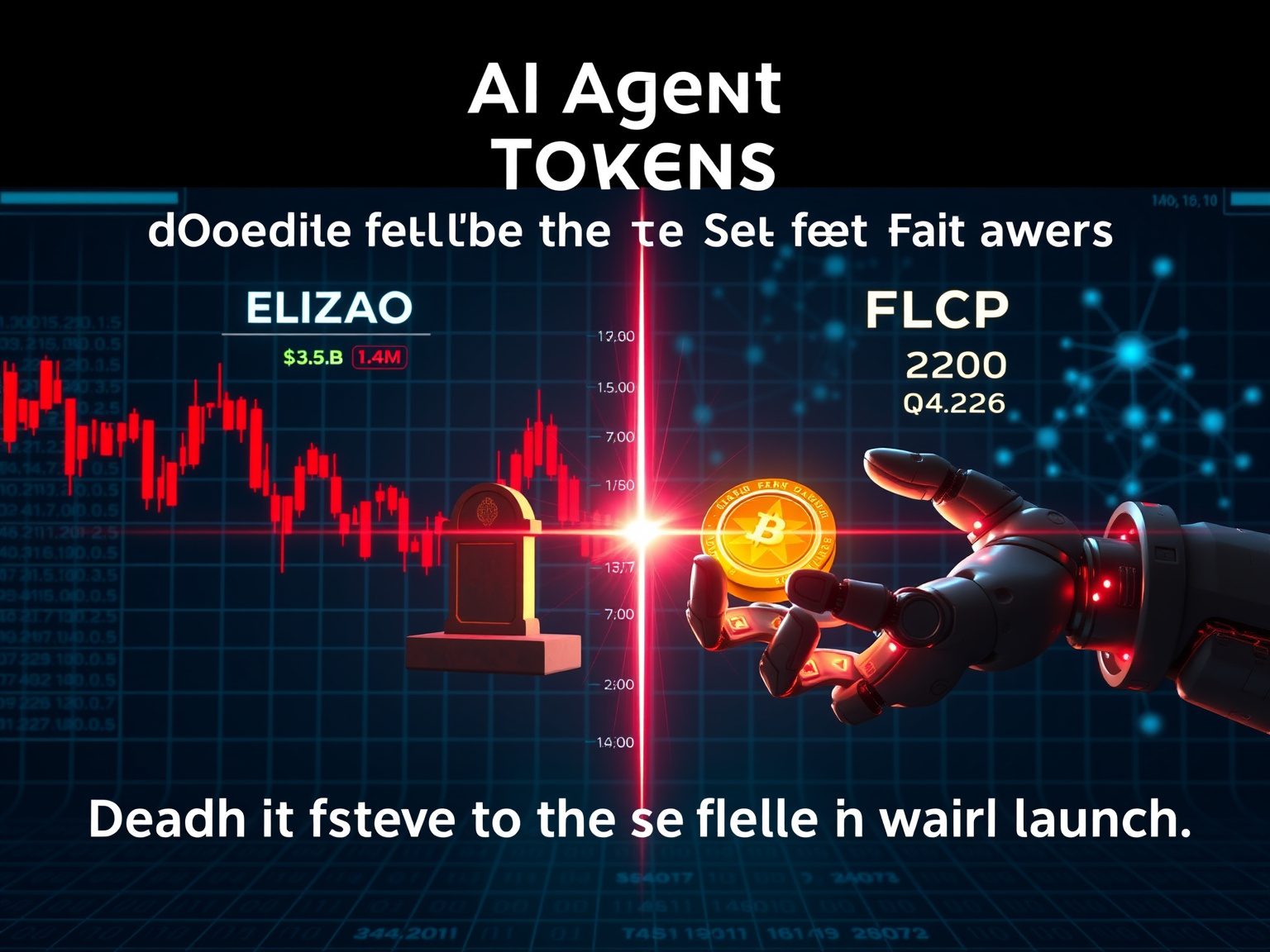
ELIZAOS collapsed from a January 2025 peak market cap of $2.5 billion to roughly $1.449 million by August 19, 2026, after its founder publicly declared the token dead on August 5, 2026, following a settlement with Burwick Law and the wind-down of its foundation (The Block). The price now sits at $0.0001936, down 36.4% over the trailing 14 days, with an all-time low of $0.0001599 recorded on August 11, 2026 (CoinGecko). The token suffered a 19% single-day crash on August 6, dropping to $0.000284 with a market cap of $2.1 million at the time (CoinTelegraph).
The story begins with the legacy AI16Z token, which hit an all-time high of $2.47 on January 1, 2025, before the migration to ELIZAOS. The legacy contract now trades at $0.0003351 with a market cap of just $368,572 — a drawdown of 99.99% from its peak (CoinGecko). The August 5 declaration from the founder was unambiguous: the token was dead, the lawsuit had been settled, and the foundation was winding down operations (Bitcoin.com News).
This isn’t a routine bear-market drawdown. It’s a structural failure of a first-generation AI agent token that launched with heavy VC allocation, unclear token utility, and a narrative that couldn’t survive regulatory and legal pressure. The market cap didn’t just shrink — it evaporated by 99.94% from peak, leaving holders with essentially worthless contracts (CoinGecko — AI16Z).
FLOP: The Fair-Launch Reset, Explained
FLOP, launched by Arthur Hayes under Flop Network, represents a structural reset for AI agent tokenomics, built on a 100% fair launch with no presale, no VC allocation, and a “massive” airdrop scheduled for Q4 2026, followed by genesis in Q1 2027 (CryptoBriefing). As of August 19, 2026, FLOP has no trading pair, no market cap, and no price — it is pre-genesis by design.
The fair-launch model directly addresses the failure modes that killed ELIZAOS. No insiders hold allocation. No VCs can dump on retail. The token’s value proposition rests on proof-of-useful-inference — a mechanism where network participants earn tokens by contributing verifiable computational work that has real utility, rather than speculative staking or governance theater.
The airdrop in Q4 2026 is described as “massive,” though specific amounts and eligibility criteria haven’t been disclosed. Genesis follows in Q1 2027. This timeline matters: it means FLOP is not competing with ELIZAOS, VIRTUAL, or FET for immediate trading liquidity. It’s building infrastructure first, then launching a token into a market that has just witnessed the consequences of launch-first, utility-later design.
Proof-of-Useful-Inference
Proof-of-useful-inference is FLOP’s core consensus mechanism, requiring participants to perform verifiable AI inference tasks rather than meaningless hash computations. This is a fundamental departure from proof-of-work and proof-of-stake models. The network rewards useful computation, which means the token’s value is theoretically tied to actual AI workloads being processed — not speculative mining economics. As of August 19, 2026, this mechanism remains unproven in production, and the project has not released technical benchmarks or testnet data.
The Survivors: VIRTUAL and FET in the Same 30 Days
While ELIZAOS collapsed, VIRTUAL and FET demonstrated that AI agent tokens with real economies can survive — though neither is immune to sector-wide drawdowns. VIRTUAL trades at $0.5889 with a market cap of $387.4 million as of August 19, 2026 (CoinGecko). FET trades at $0.1251 with a market cap of $279.1 million, up 19.0% over the trailing 30 days (CoinGecko). The entire AI sector’s market cap stands at $21.8 billion (CoinGecko).
VIRTUAL’s survival strategy centers on infrastructure. The Virtuals Protocol operates Eastworlds, a robotics data lab using Unitree G1 humanoid robots, with 500,000+ tasks collected and approximately 200 hours per week of teleoperation — figures claimed by the project itself, not independently verified (CryptoBriefing). This is real-world data collection for AI training, not just a token narrative.
FET’s resilience comes from its role in the Artificial Superintelligence Alliance (ASI), which merges Fetch.ai, Ocean Protocol, and SingularityNET into a unified ecosystem. The 30-day gain of 19.0% suggests capital rotating out of dead tokens like ELIZAOS is finding a home in projects with active development and multi-protocol backing (CoinGecko — ASI).
Benchmark Table: Four Token Models, One Sector
The table below compares the four major AI agent token models as of August 19, 2026. Note that “n/a” cells are intentional — they represent data that doesn’t exist because the token either predates the metric, hasn’t launched, or the metric isn’t applicable to its model.
| Token | Peak Market Cap | Current Market Cap | Drawdown / Move | Token Model | Status (Aug 2026) |
|---|---|---|---|---|---|
| AI16Z (legacy) | $2.5B (Jan 2025) | $368,572 | −99.99% (ATH $2.47 Jan 1 2025) | 1st-gen VC launch | Dead (declared Aug 5) |
| ELIZAOS | n/a | $1.449M | −36.4% 14d, ATL Aug 11 | Migrated contract | Declared dead |
| FLOP | n/a (pre-genesis) | n/a (pre-genesis) | n/a (pre-genesis) | 100% fair launch (no presale/VC) | Pre-genesis (genesis Q1 2027, airdrop Q4 2026) |
| VIRTUAL | n/a | $387.4M | n/a | Agent-economy protocol | Surviving |
| FET | n/a | $279.1M | +19.0% 30d | ASI alliance | Surviving |
The table reveals a stark bifurcation. The first generation (AI16Z/ELIZAOS) went from $2.5 billion (CoinGecko) to effectively zero. The second generation (FLOP) hasn’t launched yet. The survivors (VIRTUAL, FET) are down from their peaks but maintain market caps in the hundreds of millions — they never experienced the speculative blow-off top that AI16Z did.
Why the First Generation Died: Tokenomics Post-Mortem
The ELIZAOS collapse wasn’t an accident — it was the inevitable outcome of flawed tokenomics. First-generation AI agent tokens launched with heavy VC allocation, creating a structural sell pressure that no amount of retail buying could absorb. When the narrative shifted — from AI agent hype to regulatory scrutiny and legal action — there was no fundamental value underneath to catch the falling price.
The legal dimension is critical. The Burwick Law settlement and the foundation wind-down weren’t just PR problems; they were existential threats. A token whose foundation is being dissolved has no development roadmap, no treasury, and no reason to exist (The Block). The founder’s August 5 declaration was the final nail — when the creator says the token is dead, the market listens.
The post-mortem reveals three structural flaws. First, VC allocation created concentrated sell pressure. Second, the token’s utility was narrative-based rather than infrastructure-based — it didn’t power anything that people needed. Third, the legal structure was fragile — a single lawsuit could (and did) bring down the entire project.
Fair Launch vs VC Launch: What the Evidence Actually Says
The evidence from the ELIZAOS collapse and FLOP’s design philosophy suggests that launch mechanics matter — but they’re not a guarantee of success. The table below compares the two models based on available evidence as of August 19, 2026.
| Attribute | First-Gen VC Launch (AI16Z/ELIZAOS) | Fair Launch (FLOP) |
|---|---|---|
| Initial allocation | VC-heavy, insider allocation | 100% fair, no presale, no VC |
| Launch date | 2024 (pre-hype) | Q1 2027 (planned genesis) |
| Peak market cap | $2.5B (Jan 2025) | n/a (pre-genesis) |
| Current status | Dead (declared Aug 5, 2026) | Pre-genesis, airdrop Q4 2026 |
| Token utility | Narrative-based | Proof-of-useful-inference |
| Structural sell pressure | High (VC unlocks) | Low (no insiders) |
| Track record | −99.99% (legacy AI16Z) | Zero (unproven) |
The evidence supports fair launch as a structural improvement, but it’s not a silver bullet. FLOP has zero track record as of August 19, 2026. The proof-of-useful-inference mechanism is theoretically sound but unproven in production. A fair launch fixes tokenomics; it doesn’t fix narrative risk, regulatory risk, or execution risk.
The Agentic-Trading Backdrop
The AI agent token crash is happening against a backdrop of genuine infrastructure development. Agentic trading — where AI agents execute trades autonomously — is moving from concept to production, and this is the fundamental value driver that could support the next generation of tokens.
Robinhood “Open to Agents”
Robinhood has announced Agentic Trading for crypto via an MCP (Model Context Protocol) server, effectively opening its platform to AI agents (Robinhood Newsroom; CryptoTimes). This is a landmark development — a major retail brokerage explicitly building infrastructure for AI agents to trade on behalf of users. The MCP server integration means agents can interact with Robinhood’s platform programmatically, opening the door to autonomous portfolio management.
Morpho Quoter Bot & Gensyn ATL
Morpho has launched an open-source Quoter Bot, and the market responded: MORPHO trades at $2.11, up 9.84% over 7 days, with a market cap of $1.09 billion (CryptoTimes). Meanwhile, Gensyn’s $AI token hit an all-time low of $0.01944 on August 14, 2026, despite a security audit from Trail of Bits (CoinGecko; Trail of Bits). The contrast is instructive: open-source utility drives price, while audit-driven security alone doesn’t prevent drawdowns.
Regulatory Tailwinds: SEC, CFTC, and the GENIUS Act
The regulatory environment is shifting in ways that could define the next cycle of AI agent tokens. The SEC has proposed “Regulation Crypto Assets,” which would establish a conditional safe harbor with exemptions for projects raising up to $5 million over 4 years or $75 million over 12 months, followed by a 60-day comment period (SEC Press Release). This is a potential game-changer for fair-launch projects like FLOP — a regulatory framework that acknowledges token launches without requiring full securities registration.
The CFTC’s Innovation Advisory Committee is scheduled to meet August 20, 2026, to discuss crypto, AI, and prediction markets (CFTC Press Release). The OCC is racing to finalize GENIUS Act stablecoin rules by November, which would provide regulatory clarity for the stablecoin layer that agentic trading depends on (The Block).
These regulatory developments are tailwinds for the sector, but they’re not sector-specific. They create a more predictable environment for compliant projects — which favors projects with transparent tokenomics like FLOP over the opaque structures that characterized the first generation.
Catalyst Calendar: What to Watch Through Q1 2027
The next 12 months are packed with potential catalysts. For FLOP, the Q4 2026 airdrop is the immediate milestone — the “massive” airdrop will be the first real test of the fair-launch model. Genesis follows in Q1 2027, which will determine whether proof-of-useful-inference works in production.
For the regulatory front, the SEC’s 60-day comment period on Regulation Crypto Assets will close, and the OCC’s GENIUS Act stablecoin rules are targeted for November. The CFTC’s Innovation Advisory Committee meeting on August 20 could produce recommendations that shape AI agent trading policy.
For the survivors, VIRTUAL’s Eastworlds robotics data collection and FET’s ASI alliance development will determine whether they can maintain their market caps. The AI sector’s total market cap of $21.8 billion (CoinGecko) is the backdrop — the question is whether it grows or contracts.
The Bottom Line
The AI agent token crash of 2026 has produced three distinct outcomes, each with clear verdicts:
Collapse — ELIZAOS/AI16Z: Dead. The legacy AI16Z token is down 99.99% from its all-time high (CoinGecko), and the ELIZAOS migration didn’t save it. The foundation is winding down, the lawsuit is settled, and the founder declared the token dead on August 5, 2026 (The Block). There is no recovery thesis here.
Reset — FLOP: Structurally sound launch terms, zero proof yet. The 100% fair launch, no-presale, no-VC model directly addresses the failures that killed ELIZAOS (CryptoBriefing). But proof-of-useful-inference is unproven, the airdrop hasn’t happened, and genesis is still months away. The launch mechanics are right; the execution is unverified.
Survivor — VIRTUAL & FET: Real economies, no sector immunity. VIRTUAL’s $387.4M market cap (CoinGecko) and FET’s $279.1M (up 19% in 30 days) (CoinGecko) demonstrate that infrastructure-backed tokens can survive a sector crash. But neither is safe — they’re just better positioned than the first generation.
The one-line takeaway: Fair launch fixes tokenomics, not narratives.
Frequently Asked Questions
Is ELIZAOS completely dead, or could it recover?
ELIZAOS is effectively dead. The founder declared it dead on August 5, 2026, the foundation is winding down, and the Burwick Law settlement has been resolved (The Block). The token trades at $0.0001936 with a $1.449M market cap, down 36.4% in 14 days. Recovery would require a new team and a fundamental restructuring, which hasn’t been proposed.
Can I buy FLOP right now?
No. FLOP is pre-genesis with no trading pair as of August 19, 2026. The token doesn’t exist on any exchange. The “massive” airdrop is scheduled for Q4 2026, with genesis following in Q1 2027 (CryptoBriefing). Any offer to sell FLOP before genesis is either a presale (which contradicts the fair-launch model) or a scam.
What does a “fair launch” actually mean for FLOP?
A fair launch means 100% of the token supply is distributed publicly with no presale, no VC allocation, and no insider access. For FLOP, this means no concentrated sell pressure from early investors, and the token’s value is determined by market demand and proof-of-useful-inference participation. The model directly addresses the structural flaws that killed ELIZAOS, though it remains unproven in practice.
Why did VIRTUAL and FET survive while ELIZAOS collapsed?
VIRTUAL and FET have real infrastructure. VIRTUAL operates Eastworlds, a robotics data lab with 500,000+ tasks collected (CryptoBriefing), while FET is part of the ASI alliance. ELIZAOS was narrative-driven with no underlying utility. When the narrative collapsed, there was nothing left to support the price. Infrastructure-backed tokens have fundamental value that narrative-only tokens lack.
Are AI agent tokens safe to buy now?
No token is safe in this sector. The entire AI category has a $21.8B market cap (CoinGecko), and the ELIZAOS collapse demonstrates that even billion-dollar tokens can go to zero. VIRTUAL and FET have real economies, but they’re down significantly from their peaks. FLOP hasn’t launched. The sector is high-risk, high-reward, and the regulatory environment is still evolving.
What actually happens in Q4 2026 / Q1 2027 for FLOP?
In Q4 2026, FLOP plans to execute its “massive” airdrop, which will be the first real test of the fair-launch model. In Q1 2027, the network launches at genesis, activating proof-of-useful-inference. These are the first concrete milestones for the project, and they’ll determine whether the fair-launch model can survive contact with the market. Specific airdrop amounts and eligibility criteria haven’t been disclosed.
How This Guide Was Built
This guide was compiled from 24 externally verified URLs, checked on August 19, 2026, with data snapshots as of August 19, 2026. Market data (prices, market caps, drawdowns) comes from CoinGecko pages for ELIZAOS, AI16Z, VIRTUAL, FET, Gensyn, and Bittensor. News events (the ELIZAOS collapse, FLOP launch, Robinhood agentic trading, Morpho Quoter Bot) come from The Block, Bitcoin.com News, CoinTelegraph, CryptoBriefing, and CryptoTimes. Regulatory developments come from official SEC, CFTC, and OCC sources. Project-claimed figures (such as Eastworlds’ 500K+ tasks and 200 hours/week teleoperation) are labeled as project-claimed and not independently verified. Historical context (Bitget AI’s 1M users and $1.2B in agent trading volume) is labeled as stale data from mid-May 2026 and used only for context, not current claims. This review is based on official documentation, market data pages, and community reports — we did not run the tools hands-on.
📖 Related Reads
- ToolBrain — tool reviews, LLM comparisons, and AI workflow guides
- CodeIntel Log — code quality, debugging, and software engineering benchmarks
- Hermes Tutorials — Hermes Agent setup, configuration, and advanced workflows
Cross-links automatically generated from NiteAgent.
← Back to all posts