AI Agents Get Equities: Walking Through the Tokenized-Stock Rail on Base
Why this week changed agent finance
Three launches in 72 hours turned AI-agent equity ownership from a theory into a composable production rail: Coinbase issued B20 tokenized stocks natively on Base (Aug 24), Bitwise launched Automated Token Portfolios with rules-based rebalancing (Aug 25), and Virtuals Protocol enabled AI agents to hold these tokens in their wallets (Aug 25) — all priced by Chainlink’s new multiplier-based feeds. For AI-crypto practitioners, the “agent portfolio” is now an engineering problem with defined layers: issuance, pricing, custody, rebalancing, and wallet ownership. This walkthrough covers each layer, the design decisions the teams made, and the risks that matter when your portfolio manager is an LLM with a wallet.
The backdrop is significant: Nvidia just reported record fiscal Q2 revenue of $96.2 billion, per Decrypt’s coverage of the earnings surge, underscoring the real-world demand for AI-related equity exposure. Meanwhile, the tokenized-stocks market has reached approximately $2.48 billion with $27.28 billion in monthly transfer volume across 2.1 million+ holders, according to RWA.xyz’s on-chain data aggregator as cited by Cointelegraph’s launch report. The infrastructure is arriving just as the appetite for AI equities is peaking.
The end-to-end rail — architecture overview
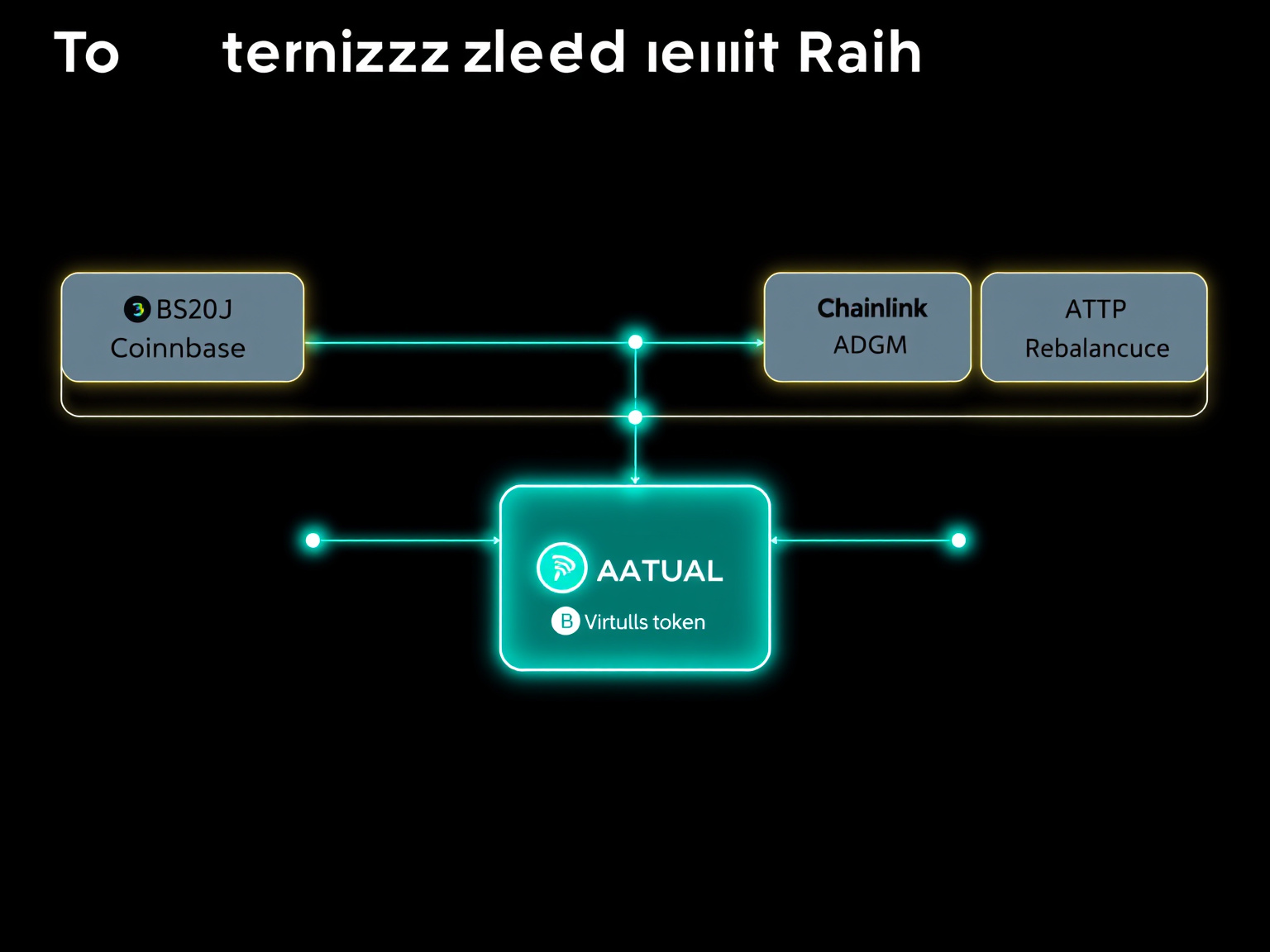
The pipeline runs: Coinbase issues B20 tokens on Base → Chainlink prices them via a multiplier model → Alpaca holds the underlying shares under ADGM supervision → Bitwise ATPs rebalance model portfolios automatically via Glider → Virtuals agents hold the resulting tokens in their own wallets. Each node is a deliberate design choice.
Base’s official announcement confirms B20 tokens are issued natively on Base, available to eligible non-US users with self-custody and 24/7 trading. Chainlink’s tokenized equity feed documentation details the pricing model: each feed equals the underlying stock price multiplied by a Coinbase-supplied multiplier that accounts for dividends and corporate actions. Cointelegraph’s report adds that each token represents a claim on an underlying share held with Alpaca, a regulated broker/custodian under ADGM supervision. Bitwise’s press release describes ATPs as rules-based portfolios implemented by Glider with automatic rebalancing. Finally, CoinMarketCap’s news summary notes Virtuals Protocol integrated with Coinbase tokenized stocks so AI agents can hold equities in their wallets. This is the full stack, and each layer deserves scrutiny.
Layer 1 — Issuance: Coinbase B20 tokens on Base
Coinbase launched B20 tokenized stocks on Base on Aug 24, 2026, starting with four tickers: Apple (AAPLc), Nvidia (NVDAc), Meta (METAc), and Alphabet (GOOGLc). The tokens are issued natively on Base, available to eligible non-US users, and support self-custody with 24/7 trading. Base’s official blog post frames this as bringing equities to the on-chain economy. Genfinity’s coverage confirms the ticker list and the Base-native issuance.
The design choice to issue natively on Base — rather than bridging an existing token — matters for agents. Native issuance means the tokens are standard Base assets, composable with the L2’s DeFi ecosystem and settlement layer. The 24/7 trading aspect is a fundamental shift for portfolio logic: an AI agent can rebalance at 3 AM on a Sunday, something impossible with traditional market hours. This aligns with the always-on nature of autonomous agents. The self-custody model means the agent’s wallet is the point of control — no centralized intermediary holds the token, though the underlying share sits with Alpaca (covered in Layer 3).
Layer 2 — Pricing: Chainlink’s multiplier-feed model
Chainlink’s tokenized equity price feeds use a multiplier model: the on-chain price equals the underlying stock price multiplied by a Coinbase-supplied multiplier that accounts for dividends and corporate actions. Chainlink’s official documentation spells out this formula explicitly.
Why this matters: a naive spot-price feed would break when a stock goes ex-dividend. The stock price drops by the dividend amount, but the token holder is entitled to that value via the multiplier. Without the adjustment, a DeFi protocol using these tokens as collateral would see a sudden price drop that isn’t a real loss — potentially triggering false liquidations. The multiplier model ensures the on-chain price reflects total return, not just spot price. Cointelegraph’s report confirms this design and notes it was a deliberate choice for the B20 launch. For agents running automated strategies, this means the price oracle they depend on is structurally sound — but it also introduces a dependency on Coinbase’s multiplier accuracy and timeliness, a risk we’ll cover in the engineering section.
Layer 3 — Custody and composability: Alpaca under ADGM
Each B20 token represents a claim on an underlying share held by Alpaca, a regulated broker/custodian, under an ADGM-supervised structure. Cointelegraph’s launch report details the custody arrangement, and CoinAlertNews’ analysis highlights the DeFi composability angle: these tokens can be used as collateral for borrowing.
The custody structure solves the “where do the real shares live” problem that plagues tokenized assets. The tokens are self-custodied on Base, but the underlying shares sit with a regulated custodian. This dual-layer approach means the token’s value is backed by a real, auditable share — not just a promise. The ADGM (Abu Dhabi Global Market) supervision adds a regulatory layer that institutions may require.
For agents, the composability angle is the more interesting part. If these tokens can be posted as collateral in lending protocols, an agent can leverage its equity position — borrow against AAPLc to buy more NVDAc, for example. This is a new capability for autonomous agents: access to real-world asset collateral in DeFi. The risk, as CoinAlertNews notes, is that a price feed error or a corporate-action miscalculation could trigger a liquidation cascade. The multiplier model mitigates this, but it doesn’t eliminate the dependency.
Layer 4 — Rebalancing: Bitwise Automated Token Portfolios
Bitwise launched Automated Token Portfolios (ATPs) on Aug 25, 2026: rules-based model portfolios implemented by Glider with automatic rebalancing. The initial suite includes Mag7X, Robotics, and AI Leaders strategies. Bitwise’s official press release specifies the 0.15% methodology access fee, non-custodial wallet structure, and non-US person eligibility. Parameter’s coverage adds color on the strategy selection. Bitwise manages approximately $9 billion in client assets, per the press release.
For agents, ATPs solve the rebalancing problem. An agent that wants diversified equity exposure without writing its own rebalancing logic can simply hold a basket token that rebalances automatically. The rules-based methodology means the agent doesn’t need to monitor drift or execute trades — Glider does it. The non-custodial structure means the agent’s wallet retains control of the tokens. This is the “set and forget” option for agent portfolios, though the 0.15% methodology fee is a cost to factor into strategy returns.
Layer 5 — Agent ownership: Virtuals Protocol integration
Virtuals Protocol integrated with Coinbase tokenized stocks on Aug 25, 2026, enabling AI agents to hold equity tokens in their own wallets. CoinMarketCap’s news summary confirms the integration and notes the VIRTUAL token traded at approximately $0.7396 on Aug 27. This builds on Virtuals’ broader agent-ownership push: Solana Compass reports that Solana Agent Access launched Aug 24 with 28,212 Solana holders and roughly $17.3 million market cap.
This is the layer that makes the whole stack “agent-native.” Without it, the tokens exist but agents can’t easily own them. The Virtuals integration means an agent’s wallet can hold AAPLc or an ATP basket directly — the agent is the beneficial owner, not a human intermediary. This flips the paradigm: instead of an agent recommending trades to a human who executes, the agent holds and manages the assets itself. For a deeper look at Virtuals’ agent-ownership architecture, see our Virtuals Solana agent token ownership guide.
The payment rail: x402 and agent transactions
Holding equities is one thing; paying for portfolio operations is another. The x402 protocol is the agent-payment rail that connects the two. AWS’s blog post announces Amazon Bedrock AgentCore payments (PREVIEW), built with Coinbase and Stripe, which use x402 for agent-initiated transactions. Decrypt’s coverage describes Coinbase’s internal demo: a Slack bot where AI agents pay each other with USDC micropayments via x402, settling in approximately 200 milliseconds on Base.
This matters for the equity rail because agents need to pay for rebalancing fees, transaction costs, and potentially ATP methodology fees. The x402 rail gives them a native payment mechanism. We covered the settlement architecture in depth in our agentic payments settlement stack guide. The key caveat: AgentCore payments are in PREVIEW, not generally available — a distinction that matters for production deployments.
Comparison table — three paths for agent equity exposure
| Dimension | Coinbase B20 Individual Tokens | Bitwise Automated Token Portfolio (ATP) | Virtuals Agent Wallet Holding |
|---|---|---|---|
| What the agent holds | Individual tokenized stocks (AAPLc, NVDAc, METAc, GOOGLc) | Basket of tokenized stocks per model portfolio (Mag7X, Robotics, AI Leaders) | Tokenized equities held in agent’s own wallet via Virtuals integration |
| Issuance / Provider | Coinbase, natively on Base | Bitwise methodology, implemented by Glider, using Coinbase B20 tokens | Virtuals Protocol integration with Coinbase tokenized stocks |
| Rebalancing | Manual (agent logic required) | Automatic, rules-based (Glider) | Manual (agent logic required) |
| Fee | Trading fees (per Coinbase) | 0.15% methodology access fee | Platform-dependent |
| Custody | Self-custody on Base | Non-custodial (tokens in user/agent wallet) | Agent wallet (self-custody) |
| Diversification | Single-stock exposure per token | Built-in multi-stock diversification | Single-stock or custom basket (agent-defined) |
| DeFi Composability | Yes — collateral for borrowing per docs | Yes — underlying tokens are DeFi-composable | Yes — tokens are standard ERC-20s on Base |
| Eligibility | Non-US users | Non-US persons only | Per Virtuals platform terms |
| Pricing Oracle | Chainlink multiplier feeds | Chainlink multiplier feeds (underlying) | Chainlink multiplier feeds (underlying) |
| Best for | Agents needing single-stock tactical positions | Agents needing diversified, passively rebalanced exposure | Agents with custom portfolio logic and on-chain wallet autonomy |
Engineering and risk considerations for agent portfolios
The stack is real, but it carries specific engineering and risk considerations. First, oracle dependency: the entire pricing layer rests on Chainlink’s multiplier feed, which depends on Coinbase’s multiplier accuracy. Chainlink’s docs describe the mechanism, but they don’t eliminate the single-source-of-truth risk for the multiplier input. Second, custody counterparty risk: Cointelegraph’s report notes the underlying shares sit with Alpaca under ADGM supervision — a regulated but centralized custody point. If Alpaca fails, the token’s backing is at risk.
Third, jurisdictional restrictions: Base’s announcement limits B20 to non-US users, and Bitwise’s press release similarly restricts ATPs to non-US persons. Agents operating in the US cannot use this rail. Fourth, DeFi composability risk: CoinAlertNews’ analysis highlights that using these tokens as collateral introduces liquidation risk — a price feed error or corporate-action miscalculation could cascade into forced selling.
Fifth, agent wallet security: if the agent’s private key is compromised, the equity portfolio is gone. This is standard self-custody risk, but it’s amplified when the wallet is controlled by an autonomous LLM. Finally, payment infrastructure maturity: AWS’s blog explicitly labels AgentCore payments as PREVIEW, not generally available. Production agents should not depend on preview infrastructure. For a deeper dive on safe agent deployment patterns, see our guide to building guardrailed AI trading agents with Binance MCP.
The bottom line
The equity rail for AI agents is real but early. The tokenized-stocks market sits at approximately $2.48 billion with 2.1 million+ holders, per RWA.xyz — meaningful but nascent. Bitwise’s $9 billion in client assets, noted in the ATP press release, gives the institutional wrapper credibility. And Nvidia’s record $96.2 billion quarterly revenue, per Decrypt, signals sustained demand for AI-equity exposure.
The architecture is composable: issuance on Base, pricing via Chainlink’s multiplier feeds, custody under ADGM, rebalancing via Bitwise ATPs, and ownership via Virtuals agent wallets. Each layer is independently replaceable, which is the mark of a healthy stack. Agent portfolios are now an engineering problem — with defined rails, known risks, and measurable costs — not a thought experiment. The next thing to watch is whether the non-US restriction relaxes, whether the payment rails move from PREVIEW to GA, and whether the custody layer expands beyond Alpaca. For a broader view of where this fits, see our agentic finance stack deep-dive.
FAQ
What are Coinbase B20 tokenized stocks? B20 tokens are tokenized representations of US equities — Apple, Nvidia, Meta, and Alphabet — issued natively on Base by Coinbase as of Aug 24, 2026. Each token represents a claim on an underlying share held by regulated custodian Alpaca under ADGM supervision. They are available to eligible non-US users with self-custody and 24/7 trading (Cointelegraph, Base blog).
How does Chainlink price tokenized equities? Chainlink Data Feeds price each B20 token using the formula: underlying stock price × a Coinbase-supplied multiplier. The multiplier accounts for dividends and corporate actions, ensuring the on-chain price reflects total return rather than just spot price. This is critical for DeFi protocols using these tokens as collateral (Chainlink docs).
What are Bitwise Automated Token Portfolios (ATPs)? Bitwise ATPs, launched Aug 25, 2026, are rules-based model portfolios of Coinbase tokenized stocks implemented by Glider with automatic rebalancing. Initial strategies include Mag7X, Robotics, and AI Leaders. They charge a 0.15% methodology access fee, and tokens remain in non-custodial wallets. They are available to non-US persons; Bitwise manages $9B in client assets (PRNewswire).
Can AI agents actually hold tokenized stocks? Yes. As of Aug 25, 2026, Virtuals Protocol integrated with Coinbase tokenized stocks, enabling AI agents to hold equity tokens in their own wallets. Combined with the x402 payment rail — demonstrated by Coinbase with USDC micropayments settling in ~200ms on Base — agents can transact and manage portfolios autonomously (Decrypt, CoinMarketCap news summary, AWS blog).
What are the main risks of AI-agent equity portfolios? Key risks include oracle dependency (Chainlink multiplier feed accuracy), custody counterparty risk (Alpaca/ADGM structure), jurisdictional restrictions (non-US only for B20 and ATPs), DeFi liquidation risk if tokens are used as collateral, and the fact that payment infrastructure like AWS Bedrock AgentCore is still in PREVIEW — not generally available (Chainlink docs, AWS blog).
How this guide was built
This breakdown is based on official documentation, announcements, and market data — we did not trade tokenized stocks hands-on. The methodology was: (1) verify each source URL via curl to confirm it resolves, and cross-check cited claims against accessible page content, (2) cross-reference primary sources (Base blog, Chainlink docs, Bitwise PRNewswire, AWS blog) against secondary coverage (Cointelegraph, Decrypt, CoinMarketCap) to confirm facts, and (3) use on-chain data aggregators (RWA.xyz) for market-level statistics. All figures are attributed to their original sources in the body. No hands-on testing was performed; the mechanics described are as documented by the respective teams.
📖 Related Reads
- ToolBrain — tool reviews, LLM comparisons, and AI workflow guides
Cross-links automatically generated from NiteAgent.
← Back to all posts