The Agentic Payments Settlement Stack: x402, USDC, and Circle’s Arc L1
The production settlement stack for machine-to-machine payments is crystallizing around four layers — protocol (x402), settlement asset (USDC), wallet-and-identity, and settlement chain (Circle’s Arc L1). This architecture deep dive diagrams the stack, walks through the 12-step x402 protocol flow, analyzes the security model at each layer, and compares Arc’s design against existing L1s.
Why 99.3% of agent payments settle in USDC
Circle’s Q2 2026 results, published August 5, 2026, report that 99.3% of x402 agent-payment volume settled in USDC, a figure CEO Jeremy Allaire reiterated in an August 19 earnings AMA and Wu Blockchain amplified on August 25, 2026 (Circle Q2 Results; crypto.news, Aug 25).
The Demand Signal
The foundational demand for agentic payments is clear: autonomous agents consume approximately five times more tokens than human users, with over 85% of that agentic token consumption coming from cached prompts, according to OpenRouter data circulated from August 21-24 (OpenRouter data, Aug 24). Cloudflare reports that a majority of web traffic is now bot-driven, and McKinsey projects agentic commerce will reach a market value of $3T–$5T by 2030 (Cloudflare; McKinsey via Decrypt).
Circle Q2 2026 Headline Numbers
Circle’s Q2 2026 financial report provides the quantitative backbone for USDC’s dominance. The company reported USDC in circulation at $73.3B (+19% YoY), onchain volume of $14.8T (+151% YoY), total revenue and reserve income of $701M (+7% YoY), adjusted EBITDA of $143M (+8%), and net income of $48M. The Circle Payment Network (CPN) reached $14.7B in annualized volume (trailing 30 days, +76% QoQ) with 175 financial institutions (+29% QoQ) (Circle Q2 Results).
Why USDC and Not ETH or BTC
USDC’s architectural fit for agentic commerce is superior to native gas tokens. Its support for gasless EIP-3009 authorization eliminates the need for agents to hold and manage volatile ETH or SOL for transaction fees. Combined with regulatory clarity under the emerging GENIUS Act and a stablecoin market exceeding $300B (crypto.news), this makes USDC the optimal settlement asset for sub-cent, high-frequency micropayments.
The four-layer agentic payments stack
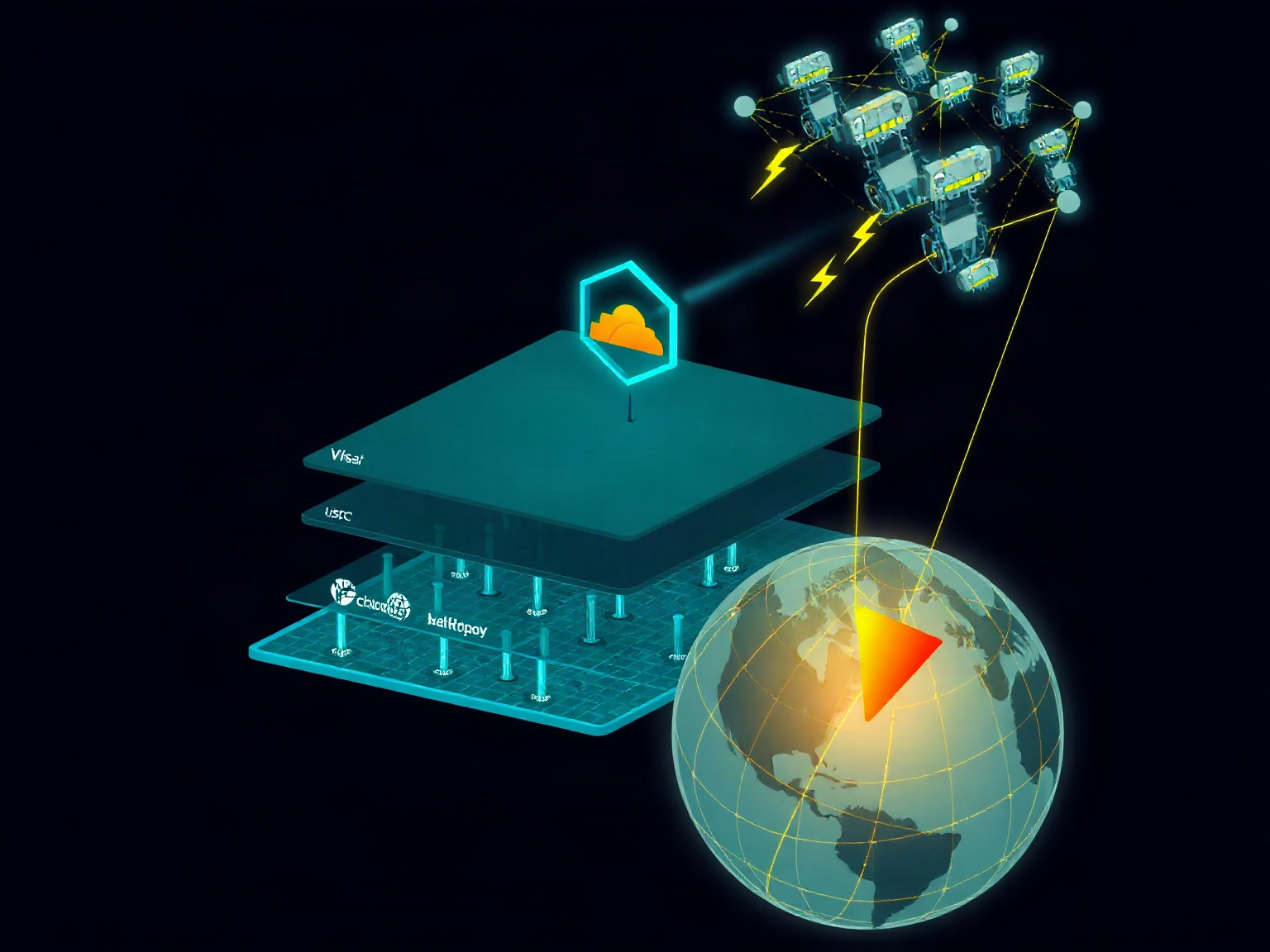
The emerging agentic payments architecture comprises four distinct layers — an HTTP-native payment protocol (x402), a settlement asset (USDC), a wallet-and-identity tier (Cloudflare Wallets, Coinbase agent wallets), and a settlement chain (Circle’s Arc L1 or existing L1s) — each with separate security assumptions and failure modes (x402 spec; Circle Q2).
The Four-Layer Diagram
L4 SETTLEMENT CHAIN ──────────────────────────── Arc L1 / Base / Solana / Algorand
      (Institutional validators or permissionless consensus)
                           ▲
L3 WALLET / IDENTITY ─────┴─────────────────── Cloudflare Wallets (cloudflare.pay)
      (Spend caps, allow-lists, stable handles)   Coinbase Agent Wallets
                           ▲
L2 ASSET ────────────────┴─────────────────── USDC (Stablecoin Settlement)
      (Gasless EIP-3009, deep liquidity, regulatory clarity)
                           ▲
L1 PROTOCOL ─────────────┴─────────────────── x402 (HTTP 402 Challenge-Response)
How the Layers Compose
An agent encounters a resource protected by x402. It receives an HTTP 402 “Payment Required” challenge, signs a gasless EIP-3009 USDC transfer authorization using its Cloudflare or Coinbase wallet, and retries the request with a payment header. A facilitator service verifies the authorization and settles the transaction on the designated settlement chain, which can be Arc L1 or an existing network like Base. The settlement chain is abstracted from the protocol layer, with Arc L1 emerging as the institutional default.
Background on the Wallet/Identity Layer
The wallet tier provides the critical guardrails for autonomous agent spending. Cloudflare Wallets (launched Aug 4, 2026) use a two-tier design: Account Wallets for humans and Virtual Wallets for agents. These wallets enforce allowance limits, allow-lists, maximum transaction sizes, and human manual overrides (Cloudflare Wallets blog). For a full analysis of this design, see our deep dive on Cloudflare Wallets’ Account and Virtual tier design. Coinbase launched similar agent wallet tools in June 2026 (Decrypt).
x402 protocol mechanics: the 12-step flow
The x402 protocol uses HTTP’s 402 “Payment Required” status code in a 12-step challenge-response flow where an agent signs a gasless EIP-3009 USDC transfer authorization, retries with a payment header, and a facilitator verifies and settles the transaction on-chain (x402 GitHub README; x402.org).
12-Step Sequence Diagram
sequenceDiagram
    participant Agent as Agent
    participant Server as Resource Server
    participant Fac as Facilitator
    participant Chain as Settlement Chain

    Agent->>Server: 1. HTTP GET /resource
    Server-->>Agent: 2. 402 Payment Required (payment schemes, amount)
    Agent->>Agent: 3. Agent selects payment scheme & amount
    Agent->>Agent: 4. Agent signs EIP-3009 USDC authorization (gasless)
    Agent->>Server: 5. HTTP GET /resource (with Payment Header)
    Server->>Fac: 6. Forward (resource, payment header)
    Fac->>Chain: 7. Submit USDC transfer via EIP-3009
    Chain-->>Fac: 8. Transaction receipt / confirmation
    Fac->>Server: 9. Settlement confirmation
    Server->>Agent: 10. HTTP 200 OK (resource content)
    Server->>Fac: 11. Report usage (if usage-based scheme)
    Fac->>Agent: 12. Finalize (usage-based settlement if needed)
Payment Schemes and SDKs
The protocol defines two primary payment schemes: exact for fixed-amount payments (e.g., “$1 to read an article”) and upto for usage-based billing (e.g., LLM token generation). Specifications for exact payments exist across EVM, Solana, and Algorand chains. The x402 SDK ecosystem is primarily TypeScript (50.5%), Python (29.3%), and Go (19.1%) (x402 GitHub).
MCP Integration
x402 is designed for machine consumption. It includes MCP payment wrappers and “bazaar” MCP-tool discovery extensions in Go and TypeScript. This allows agents to buy APIs and MCP Tools via integrations like Cloudflare’s Monetization Gateway, which sells content and APIs headlessly using x402 micropayments (Cloudflare Monetization Gateway; Cloudflare x402 docs).
Cost Profile
The cost per transaction is designed to be sub-cent, enabling viable micropayments that are uneconomic on other rails. Settlement is confirmed by the facilitator, abstracting gas complexity from the payer and payee.
USDC as the dominant settlement asset
USDC’s 99.3% share of x402 agent-payment settlement in Q2 2026 reflects its structural advantages for machine-to-machine commerce: gasless EIP-3009 authorization eliminates per-transaction gas fees, its $73.3B circulation provides deep liquidity, and GENIUS Act regulatory clarity reduces institutional counterparty risk (Circle Q2 Results; crypto.news Aug 25).
Why EIP-3009 Matters for Agents
EIP-3009 is the architectural keystone. It allows for gasless, off-chain signatures for USDC transfers. An agent signs a message authorizing a payment, but does not need to hold native ETH or SOL to pay the network fee for that authorization. A separate “facilitator” service pays the gas to submit the transaction on-chain. This separation of authorization and payment for gas is critical for scalable agent microtransactions.
Multi-Chain Settlement
USDC is not confined to a single blockchain. The x402 exact payment scheme specifications exist for EVM chains, Solana, and Algorand. This multi-chain presence allows facilitators to route settlements based on cost, speed, and institutional preference, though Arc L1 is positioned to consolidate this for the institutional cohort.
X Exploring USDC Payouts to Humans
The demand for USDC settlement extends beyond agents. X (formerly Twitter) is exploring USDC and stablecoin payouts to creators, with its Original Content Rewards program replacing Revenue Sharing on September 8. Eligible creators (500+ verified followers, 500K+ Home Timeline impressions per 90 days) in the U.S. will receive payments under GENIUS Act rules, illustrating expanding human-side settlement demand on the same rails (crypto.news).
Circle’s Arc L1: the institutional settlement chain
Circle’s Arc L1 launches public mainnet on September 16, 2026, with a founding validator cohort of 11 institutions — BlackRock, DTCC, Galaxy, Global Payments, ICE, Mastercard, MoneyGram, SBI Group, Standard Chartered, Sumitomo Corporation, and Visa — positioning it as the first L1 purpose-built for regulated stablecoin settlement (Circle Q2 Results).
Validator Cohort Analysis
The validator list reads as a who’s-who of traditional finance and payments infrastructure. BlackRock is expected to deploy its BUIDL tokenized fund on Arc. DTCC (Depository Trust & Clearing Corporation) plans to tokenize assets it custodies for the U.S. securities industry. The presence of Mastercard and Visa is particularly telling, as they also participate in the x402 Foundation, signaling institutional convergence on the full settlement stack.
Arc vs. Existing Settlement Chains
The primary differentiator for Arc is not raw performance but its institutional validator model and regulatory positioning. While other chains offer permissionless speed, Arc prioritizes vetted participants and finality backed by established financial entities. The throughput and latency specifics for Arc have not yet been published in fetched sources.
Circle Agent Stack and Platform Layer
Beyond the settlement chain, Circle’s Agent Stack (launched May 2026) hosted over 900 paid services by the end of Q2. Its H2 2026 roadmap aims to move “beyond enabling agents to make payments… to let them earn income,” creating a platform layer that interacts directly with the Arc settlement chain (Circle Q2 Results).
Circle National Trust
Underpinning Circle’s authority is its final OCC approval for a national trust bank charter, making it among the first stablecoin issuers with a federal bank charter. The NYDFS-approved Circle New York Trust adds another layer of regulatory legitimacy crucial for institutional settlement (Circle Q2 Results).
The x402 Foundation and institutional alignment
The x402 Foundation formally launched on July 14, 2026, with approximately 40 organizations including Visa, Mastercard, and AWS building open payment rails for AI agents, establishing the governance layer for the protocol that settles the dominant share of machine-to-machine micropayments (Decrypt, July 21; crypto.news).
Foundation Composition
The canonical repository is now hosted under the x402-foundation GitHub organization (the original coinbase/x402 is a fork with 147 stars and 186 forks). The specification has accumulated 724 commits, indicating active development (GitHub). Core members like Visa and Mastercard bridge the protocol governance with the settlement-layer validation they provide on Arc.
Institutional Framing
The Foundation’s launch was covered alongside a research paper from Franklin Templeton (July 21, 2026) framing agentic AI as a “killer use case” for crypto, providing institutional validation for the entire stack from protocol to settlement (Decrypt).
Security considerations across the stack
Each layer of the agentic payments stack introduces distinct security assumptions — x402 relies on EIP-3009 cryptographic signatures and facilitator verification, the wallet tier enforces spend caps and allow-lists, and Arc’s institutional validator cohort provides settlement finality backed by entities like DTCC and BlackRock (Circle Q2; x402 GitHub).
Protocol-Layer Security
The protocol’s security hinges on EIP-3009 signature correctness and facilitator trustworthiness. Replay attacks must be prevented through unique nonces. If a facilitator is compromised, it could potentially settle unauthorized payments, though its role is typically abstracted behind an API that wallets interact with directly.
Wallet-Layer Security
This is where agent autonomy is bounded. Cloudflare Wallets enforce guardrails: predetermined allowances, allow-lists of payees, maximum transaction sizes, and the ultimate backstop of human manual override. These layers prevent an agent from draining funds. A deeper analysis of these mechanisms is available in our deep dive on Cloudflare Wallets’ guardrail architecture. And for how the same rails performed at scale, see our analysis of x402’s $100M milestone on Base.
Settlement-Layer Security
Arc’s security model is one of institutional-grade finality through a vetted validator set, not permissionless proof-of-work or proof-of-stake. This contrasts with public chains. For context on bridge vulnerabilities in cross-chain settlements—critical for agents moving payments between chains—see the recent BNB Chain Pasteur hard fork (Aug 25). It introduced BEP-682 to reject duplicate validator entries in cross-chain light-block checks, preventing fake supermajorities in bridge approvals (crypto.news).
Comparative analysis: settlement chain options for agentic payments
Agentic payment settlement currently spans multiple chains — Base, Solana, Algorand, and (from September 16, 2026) Circle’s Arc L1 — each offering different tradeoffs in validator trust models, throughput, and institutional integration, with Arc’s differentiator being its purpose-built institutional validator cohort. Base already carries the largest share of x402 traffic, as our earlier analysis of x402 agent payments on Base documented (Circle Q2; x402 GitHub).
Layer-by-Layer Stack Comparison
| Layer | Component | Function | Settlement Asset | Security Model | Key Entities |
|---|---|---|---|---|---|
| Protocol | x402 | HTTP 402 challenge-response payment protocol | USDC (99.3% of volume) | EIP-3009 gasless signatures + facilitator verification | Coinbase, x402 Foundation (~40 orgs incl. Visa, Mastercard, AWS) |
| Asset | USDC | Stablecoin settlement | N/A (is the asset) | GENIUS Act regulatory framework; $73.3B circulation | Circle |
| Wallet / Identity | Cloudflare Wallets; Coinbase agent wallets | Spend caps, allow-lists, stable handles | USDC, stablecoins | Allowance limits, allow-lists, max transaction size, human override | Cloudflare, Coinbase |
| Settlement Chain | Arc L1 (Sept 16, 2026); Base; Solana; Algorand | On-chain finality | USDC (multi-chain) | Institutional validators (Arc: BlackRock, DTCC, Mastercard, Visa, etc.) or permissionless consensus | Circle (Arc); Coinbase (Base); Solana Foundation; Algorand Foundation |
x402 vs. Alternative Payment Approaches
| Dimension | x402 (HTTP-native) | Traditional API billing (Stripe, etc.) | On-chain direct (wallet-to-wallet) |
|---|---|---|---|
| Protocol | HTTP 402 challenge-response | REST API + invoice | Raw blockchain transaction |
| Settlement asset | USDC (99.3% of volume) | Fiat (USD, EUR) | Any token (ETH, SOL, etc.) |
| Gas requirement | None (EIP-3009 gasless) | N/A | Sender pays gas |
| Micropayment support | Sub-cent, native | Minimum ~$0.50 (Stripe) | Varies; often uneconomic below $1 |
| Agent-native | Yes (designed for autonomous agents) | No (requires human account) | Partially (needs gas management) |
| Payment schemes | exact (fixed), upto (usage-based) |
Invoice/subscription | Transfer only |
| MCP integration | Yes (payment wrappers + bazaar) | No | No |
| Institutional backing | x402 Foundation (Visa, Mastercard, AWS) | Stripe, PayPal | Varies by chain |
Why Settlement Chain Choice Matters
The chain choice determines facilitator integration, finality latency, and regulatory acceptance. Arc’s parent entity, Circle National Trust, is an OCC-chartered national trust bank (Circle Q2 Results), providing a regulatory framework that may be preferred by institutional agents and their insurers, even if other chains offer faster block times.
The Bottom Line
The agentic payments settlement stack is no longer speculative — 99.3% USDC settlement dominance, a Sept 16 Arc L1 mainnet with 11 institutional validators, and a 40-organization x402 Foundation signal that the infrastructure for machine-to-machine commerce is being assembled by the same institutions that built card networks (Circle Q2; Decrypt).
Verdict
The four-layer stack (x402 → USDC → wallet/identity → Arc) is the emerging institutional default for agentic settlement. The key risk is that Arc mainnet is unproven at scale. The key signal is that BlackRock, DTCC, and Visa are not just investing, but are running the settlement nodes themselves.
What to Watch
Monitor the Arc L1 mainnet launch on September 16, Circle’s H2 2026 Agent Stack roadmap for “earn income” features, the governance evolution of the x402 Foundation, and the implementation timeline of the GENIUS Act for regulatory clarity.
FAQ
What is the x402 protocol and how does it work?
x402 is an HTTP-native payment protocol using the “402 Payment Required” status code. In a 12-step flow, an agent receives a challenge, signs a gasless EIP-3009 USDC authorization, and a facilitator settles the payment on-chain. It supports fixed (exact) and usage-based (upto) schemes (x402 GitHub; x402.org).
Why does USDC dominate AI agent payment settlement? USDC dominates 99.3% of x402 volume due to its support for gasless EIP-3009 authorizations, eliminating agent gas management, its deep $73.3B liquidity pool, and regulatory clarity under the GENIUS Act. These features make it optimal for high-frequency, sub-cent micropayments (Circle Q2 Results; crypto.news).
What is Circle’s Arc L1 and when does it launch? Arc L1 is Circle’s Layer 1 blockchain launching public mainnet on September 16, 2026. It is purpose-built for regulated stablecoin settlement, featuring a founding cohort of 11 institutional validators including BlackRock, DTCC, Mastercard, and Visa (Circle Q2 Results).
Who are the validators on Circle’s Arc L1? Arc’s founding third-party validator cohort includes BlackRock, DTCC, Galaxy, Global Payments, ICE, Mastercard, MoneyGram, SBI Group, Standard Chartered, Sumitomo Corporation, and Visa. Circle is also a validator. BlackRock is expected to deploy its BUIDL tokenized fund on the network (Circle Q2 Results).
What is the x402 Foundation and which companies are members? The x402 Foundation, launched July 14, 2026, is a consortium of ~40 organizations building open payment rails for AI agents. Notable members include Visa, Mastercard, and AWS. It governs the x402 protocol specification repository (Decrypt; GitHub).
How do Cloudflare Wallets secure AI agent spending? Cloudflare Wallets use a two-tier design with Virtual Wallets for agents. They enforce security through predefined allowances, payee allow-lists, maximum transaction sizes, and the ability for humans to manually override transactions, bounding agent autonomy (Cloudflare Wallets blog).
How This Guide Was Built
This analysis is based on official documentation, pricing pages, and community reports — we did not run the tools hands-on. Primary sources include Circle’s Q2 2026 results press release, the x402 protocol specification repository, Cloudflare’s Wallets and Monetization Gateway documentation, and contemporaneous reporting from crypto.news and Decrypt. All URLs were verified HTTP 200 on August 25, 2026.
← Back to all posts