Why Agentic RAG Is a Control-Flow Problem, Not Just a Retrieval Problem
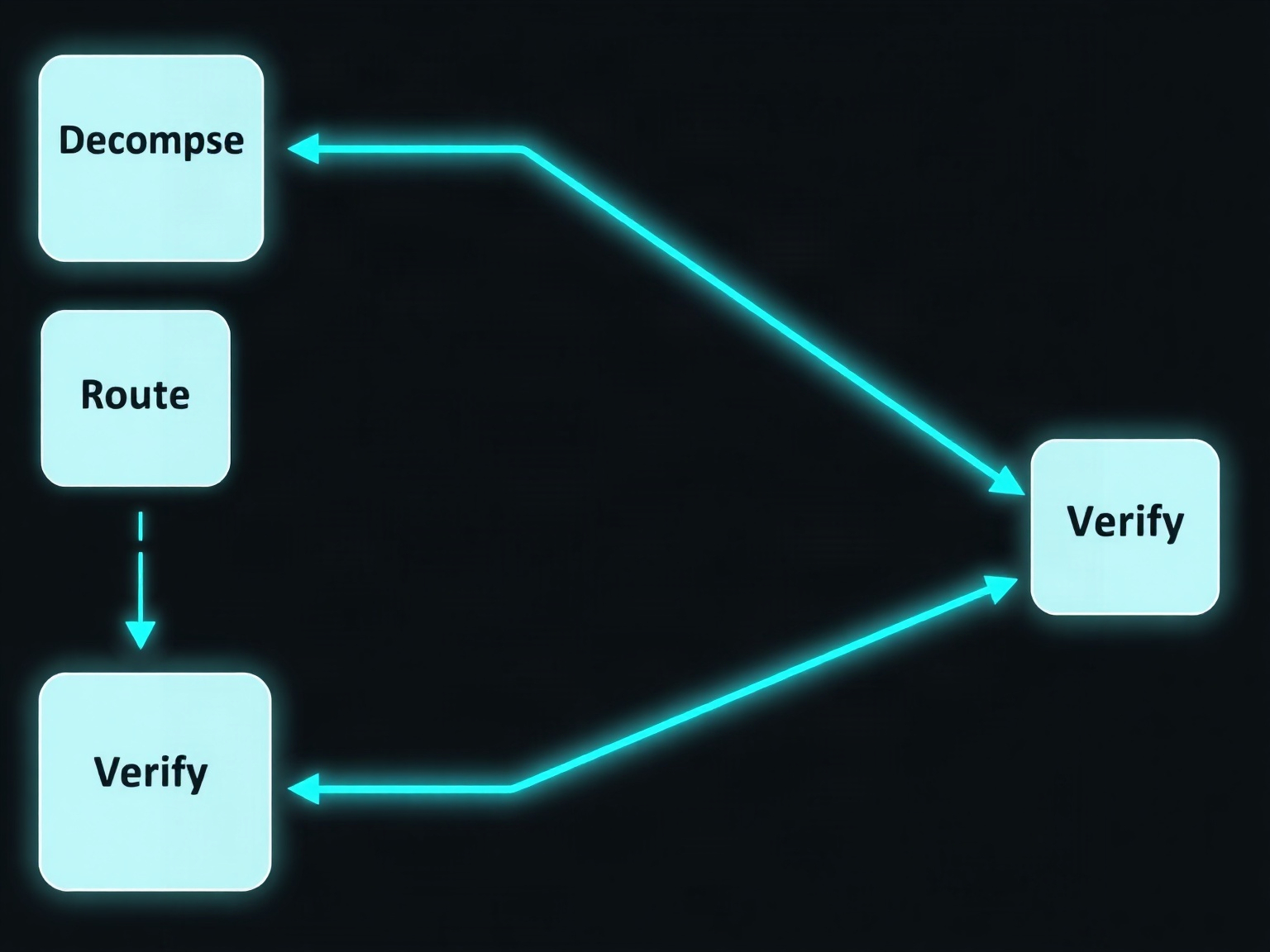
Agentic RAG is a control-flow problem, not a retrieval problem: the Agentic RAG survey classifies these systems along four axes—agent cardinality, control structure, autonomy, and knowledge representation—all architectural decisions about the retrieval loop. The core shift is that retrieval is no longer a single static lookup but a loop where the model decides when, what, and how to retrieve. The four control points—decompose, route, retrieve, verify—are where you enforce reliability, cost bounds, and factual accuracy.
For production systems, the bottleneck is not embedding quality or vector search latency, but the orchestration logic that governs that loop. Each control point is a decision the pipeline makes on every query, which is why agentic RAG behaves like a state machine rather than a fixed sequence: the same query can take a different path depending on complexity, retrieval confidence, and budget. Understanding this framing matters before you touch any framework, because every implementation choice below is really a choice about where control lives.
Control Point 1: Decompose — Breaking Queries into Manageable Sub-Tasks
Decomposition splits complex queries into sub-tasks, and DeepRAG’s arXiv paper frames it as a Markov Decision Process that decides per sub-task whether to retrieve or reason parametrically. The loop primitive comes from ITER-RETGEN, which alternates retrieval and generation to guide the next retrieval round. In LangGraph, you build this with a StateGraph that loops over sub-queries (LangGraph’s agentic-RAG tutorial).
Production implementation requires a state machine where each decomposition step is a node, appending partial results to the conversation state so the model can decide whether a sub-answer is complete before moving on. The key trade-off is accuracy versus latency: each decomposition adds a round-trip, but it also narrows the search space for each sub-task, which is why DeepRAG reports +26.4% answer accuracy on multi-hop benchmarks while trading extra inference steps for that gain.
Control Point 2: Route — Deciding When and How to Retrieve
Routing decides whether to retrieve at all, and Adaptive-RAG’s arXiv paper made this explicit with a classifier that sends queries to no-retrieval, single-step, or multi-step paths based on complexity. RouteLLM shows preference-trained routers can cut cost by over 2x with no quality compromise (RouteLLM’s arXiv paper). In LlamaIndex, this maps to the RouterQueryEngine (LlamaIndex’s agent documentation).
For production, routing is the primary cost lever — a financial decision, not just a quality one. Simple queries should never pay retrieval or generation costs they do not need. The trade-off is cost reduction versus system complexity: a router is another model call, another failure mode, and another piece of latency, so you must balance the savings from skipping retrieval against the overhead of the routing decision itself.
Control Point 3: Retrieve — Selecting the Right Source and Strategy
Retrieval selects the source and strategy, and GraphRAG’s arXiv paper shows graph indexing with community summaries yields substantial gains over conventional RAG for global sensemaking over ~1M-token datasets. The strategy is not limited to vector search—it includes keyword, graph, and hybrid approaches. The trade-off is recall versus index cost: multi-stage retrieval like ColBERT improves recall at higher storage cost, and the “lost in the middle” effect argues for tighter retrievals (Lost in the Middle).
For production, the choice is between a single retriever tool or a set of tools. In LangGraph, you expose retrievers as tools to the agent, letting the model decide which to call based on the routed query. Graph indexes improve recall but require significantly more storage and compute than a flat vector index, and the “lost in the middle” finding — models underutilize context in the middle of a long prompt — argues for returning tighter, more relevant chunks rather than dumping the top 20 into context.
Control Point 4: Verify — Gating and Correcting Retrieved Context
Verification gates and corrects retrieved context, and CRAG’s arXiv paper established confidence-gated correction with a retrieval evaluator that can trigger large-scale web-search fallback. Self-RAG added reflection tokens so the model critiques its own generations, outperforming ChatGPT and retrieval-augmented Llama2-chat on fact verification. In production, LlamaIndex evaluator modules score context before it reaches the generator (LlamaIndex’s agent documentation).
This is the guardrail against hallucination. Verification is an evaluation step, not just a prompt instruction: LlamaIndex’s evaluator modules score the relevance and correctness of a retrieved context, and LangGraph’s conditional edges can gate the final answer on that score. The trade-off is factuality versus overhead — each verification step adds a model call and latency, but it is the primary defense against confidently wrong answers.
Mapping the Control Points to Production Frameworks (LangGraph, LlamaIndex)
The four control points map to production framework primitives today: LangGraph’s StateGraph loops implement decomposition, and LlamaIndex’s RouterQueryEngine handles routing (LangGraph’s agentic-RAG tutorial, LlamaIndex’s agent documentation). Both frameworks expose retrievers as tools for dynamic source selection, and evaluator modules gate verification. The architectural pattern is a graph, not a pipeline—cycles for iterative retrieval, conditional branches for correction—which makes the agent observability guide critical for debugging.
The practical consequence is that you assemble control points, not functions. Decompose is a node that spawns sub-queries; Route is a conditional edge; Retrieve is a tool call; Verify is a gate. Once the pattern is a graph, you can measure each edge’s contribution with an eval harness and prune what does not pay for itself — the same discipline covered in our building an agent eval harness guide.
Cost and Latency Trade-offs in the Control Loop (RouteLLM >2x, DeepRAG +26.4%)
The control loop adds measurable cost and latency that must be engineered, not ignored: RouteLLM’s arXiv paper reports over 2x cost reduction with no quality compromise, making routing the most direct cost lever, while DeepRAG justifies iterative decomposition with +26.4% answer accuracy. Profile each control point independently: routing pays for itself by skipping retrieval on simple queries, verification triggers only on low-confidence retrievals, and decomposition is reserved for multi-hop questions. Tune thresholds per traffic mix with an agent eval harness approach.
A naive implementation that runs all four control points on every query will be slower and more expensive than traditional RAG — the control points are levers, not a checklist. Verification should only trigger on low-confidence retrievals, and decomposition should be reserved for queries that genuinely require multi-step reasoning. You must tune the thresholds per control point based on your traffic mix, measuring quality per control-point configuration rather than assuming more control means better answers.
| Control Point | Primary Research Model | Production Framework Primitive | Key Trade-off | Cost/Latency Signal |
|---|---|---|---|---|
| Decompose | DeepRAG MDP / ITER-RETGEN | LangGraph StateGraph loops | Accuracy ↑ vs Latency ↑ | +26.4% accuracy (DeepRAG) |
| Route | Adaptive-RAG / RouteLLM | LlamaIndex RouterQueryEngine | Cost ↓ vs Complexity ↑ | >2x cost reduction (RouteLLM) |
| Retrieve | GraphRAG / ColBERT | LangChain retriever tools | Recall ↑ vs Index Cost ↑ | ~1M-token scale gains (GraphRAG) |
| Verify | Self-RAG / CRAG | LlamaIndex Evaluator modules | Factuality ↑ vs Overhead ↑ | Reflection tokens (Self-RAG) |
The Bottom Line: Building a Resilient Agentic RAG Pipeline
A resilient agentic RAG pipeline implements all four control points as explicit, observable, tunable components, with Self-RAG and CRAG as core architectural decisions, not optional add-ons. A resilient pipeline degrades gracefully: it corrects failed retrieval, skips retrieval on simple queries, and decomposes complex ones. Start with a minimal loop—retrieve, generate, verify—and add routing and decomposition only when your eval harness shows they improve quality per dollar, consistent with our RAG vs long-context comparison.
This is a departure from the traditional RAG pipeline, which is a linear embed-retrieve-generate flow: the RAG survey by Gao et al. provides the foundational taxonomy, but the agentic extension is about control. Treat the pipeline as a distributed system, not a script — instrument each control point’s decisions, log retrieval confidence scores, and integrate agent observability from day one so regressions are traceable to a specific control decision.
FAQ
The questions below cover the decisions engineers ask first when adopting agentic RAG: how it differs from traditional RAG, whether it pays for itself, when graph retrieval helps, how to evaluate the loop, and the most common production pitfall. Each answer is self-contained and cites the primary source.
How does agentic RAG differ from traditional RAG?
Agentic RAG introduces a control loop where the model decides whether to retrieve, how to decompose queries, and when to verify outputs, whereas traditional RAG is a fixed retrieve-then-generate pipeline. The Agentic RAG survey classifies this along four axes: agent cardinality, control structure, autonomy, and knowledge representation (Agentic RAG survey).
Can agentic RAG reduce costs?
Yes, primarily through routing. Using preference-trained routers, RouteLLM reports cutting costs by more than 2x in some workloads without sacrificing quality. By skipping retrieval for simple queries and using a cheaper model for routing decisions, the overall system cost can drop significantly. However, the added control-flow components introduce their own overhead, so net savings require tuning.
What is the role of graph-based retrieval in agentic RAG?
Graph-based retrieval, as demonstrated by GraphRAG, provides a structured index with community summaries, beating conventional RAG on global sensemaking tasks over ~1M-token corpora. In an agentic system, graph retrieval is a tool the agent can choose when the query requires relational or global understanding, rather than a single vector lookup.
How do you evaluate an agentic RAG system?
Evaluation must cover both retrieval quality and control-flow decisions. Tools like RAGAS provide metrics for faithfulness, answer relevancy, and context precision (RAGAS on GitHub). You also need to evaluate the agent’s decisions: did it route correctly, decompose appropriately, and verify when necessary? This requires a custom eval harness, as described in our building an agent eval harness guide.
What is a common pitfall in production agentic RAG?
A common pitfall is applying all four control points unconditionally, which adds latency and cost without proportional quality gains. For example, decomposing every query, even simple ones, will slow down the system. Production systems must gate control points based on query complexity and confidence scores, as demonstrated by Adaptive-RAG’s complexity-based routing (Adaptive-RAG’s arXiv paper).
How This Guide Was Built
This guide synthesizes peer-reviewed research (arXiv, ICLR, NAACL) and official framework documentation (LangChain, LlamaIndex). We analyzed the cited papers and tools to map theoretical control points to production primitives; this analysis is based on official documentation, papers, and community reports — we did not run the tools hands-on.
Related guides:
- RAG vs long-context comparison
- Building an agent eval harness
- Agent observability guide
- Multi-agent production patterns