Progressive Delivery for AI Agents: Canary, Shadow, and Champion-Challenger Rollouts
Why Agent Releases Break the Classic Deploy Pipeline
Agent releases break the classic deploy pipeline because non-deterministic outputs, prompt-as-config, and model/tool drift mean a deploy is now a versioned change to prompt, model, tool set, or graph config, not just code. Evaluation platforms document this shift: LangSmith’s evaluation concepts span pre-deployment testing through production monitoring, and Braintrust Evaluate notes the same input can produce different outputs.
In traditional software, a deploy is a binary swap: the same code, the same inputs, the same outputs. In agent systems, the release unit is a composite bundle: a prompt template, a model endpoint, a tool set, and a graph configuration. Each of these can change behavior independently. A prompt tweak that improves one task may silently degrade another. A model upgrade can introduce subtle hallucinations. A tool schema change can break downstream parsing. The OpenAI Agents SDK’s built-in tracing (per OpenAI Agents SDK docs) helps visualize and debug these flows, but it doesn’t solve the coordination problem: how do you ship a change safely when the artifact isn’t code?
This is where progressive delivery, the practice of staging rollouts with measurable gates and fast rollback, becomes essential. The patterns are familiar from web services: canary, shadow, blue-green, champion-challenger. Applying them to agents requires rethinking what “traffic” means, what “success” looks like, and what “rollback” entails.
What You’re Actually Shipping: Agent Release Units
The release units in agent systems are prompt versions, model endpoints behind a router, tool sets, and graph configurations, each independently versionable and independently impactful on behavior. Per Langfuse’s prompt management docs, prompts are centrally stored and versioned with instant deployment and client-side caching, while per W&B Weave’s prompt versioning docs, weave.publish creates immutable versions with :latest/:production aliases.
A prompt version is the most obvious release unit. It’s the template, system message, and few-shot examples that define agent behavior. Langfuse treats prompts as first-class versioned artifacts: updates deploy instantly, and client-side caching means no added latency. W&B Weave takes a similar approach with immutable versions and alias-based promotion.
The model endpoint is the second release unit. Behind a router like LiteLLM’s routing layer, you can split traffic across model deployments, apply fallbacks and retries, and track cooldowns. This is the primitive for model-level canaries: route 5% of requests to a new model while keeping 95% on the stable one.
The tool set is the third release unit. Adding a new tool, changing a tool’s schema, or removing a tool entirely changes what the agent can do. Unlike code libraries, tool changes don’t always fail loudly: an agent might silently avoid a deprecated tool or produce unexpected output with a new one.
The graph configuration is the fourth release unit. Whether the agent runs sequentially, in parallel, or with conditional branching is a structural decision that affects latency, cost, and reliability. LangSmith’s deployment runtime (per LangSmith Deployment docs) is purpose-built for agent workloads and supports framework-agnostic orchestration across LangGraph, Google ADK, Claude Agent SDK, CrewAI, and AutoGen.
Pattern 1: Canary and Percentage Rollouts
Canary rollouts for agents use percentage-based traffic splitting to route a small fraction of requests to a new prompt version or model endpoint, per LaunchDarkly’s percentage rollout docs, while monitoring quality metrics before expanding. Feature-flag platforms like LaunchDarkly and Statsig provide the gate layer, while LiteLLM’s router provides the traffic-splitting layer.
A canary rollout starts small. LaunchDarkly supports percentage rollouts with fine-grained allocations, including sub-1% splits, letting you start with a handful of requests LaunchDarkly percentage rollouts. Statsig recommends a staged approach: 2% → 10% → 50% → 100%, with each stage generating Pulse results for metric analysis Statsig best practices. These platforms work at the application layer: you gate on user ID, session ID, or request context.
For agent systems, the gate layer isn’t enough. You also need traffic splitting at the gateway. LiteLLM’s router (per LiteLLM routing docs) load-balances across model deployments with cooldowns, fallbacks, timeouts, and retries. This is the primitive for model-level canaries: you can split traffic between gpt-4o and gpt-4o-mini without touching application code.
The key difference from web-app canaries is what you measure. HTTP 200 isn’t enough. You need eval scores, task completion rates, hallucination checks, and cost per request. A canary that serves every request but degrades output quality is worse than no canary at all.
Pattern 2: Shadow Mode and Champion-Challenger
Shadow mode runs the candidate agent on real traffic without serving it to users, while champion-challenger compares two live versions side-by-side using LLM-as-a-judge scoring, per Braintrust’s online evaluation docs. Per Statsig’s AI evals overview, Statsig documents offline and online AI evals for this comparison, with online scoring relying on LLM-as-a-judge scorers because live requests have no ground truth.
In shadow mode, production traffic is duplicated: the champion serves the user, the challenger runs in parallel but its output is discarded. Both are logged and scored. This is especially valuable for prompt changes where the failure mode is subtle quality degradation, not hard errors. You can run a shadow challenger for days, collecting thousands of comparisons, before deciding whether to promote.
Champion-challenger is a step further. Both versions serve real users, split by a feature flag. The challenger gets a small percentage of traffic, and both are scored online. Statsig’s AI evals (per Statsig AI evals docs) support this with offline evals for pre-deployment validation and online evals for live comparison.
The cost caveat is significant. Shadow mode doubles inference cost during the evaluation window. Champion-challenger at a small traffic split adds proportional inference overhead — budget for the challenger’s share of requests.
Pattern 3: Blue-Green and Environment-Based Releases
Blue-green deployments for agents maintain two full environments, blue (production) and green (candidate), swapping traffic atomically at the router or load-balancer level with no partial exposure. Per LangSmith Deployment docs, LangSmith provides environment-based release management with Cloud, BYOC, and self-hosted options, all running the same Agent Server runtime for consistent promotion between environments.
In blue-green for agents, the candidate environment runs the full agent stack: prompt version, model endpoint, tool set, graph config, in isolation. Traffic is cut over atomically. There’s no partial rollout; it’s all or nothing. This is the safest pattern for major changes: new model families, new tool sets, or new graph topologies where percentage rollouts are insufficient.
LangSmith’s deployment model supports this natively. You deploy to a staging environment, validate with online evals, then promote to production. The same Agent Server runtime runs in Cloud, BYOC, or self-hosted configurations, keeping environments consistent.
If your agent runtime is containerized on Kubernetes, Argo Rollouts’ canary strategy docs describe declarative rollouts with setWeight steps, pause steps for manual approval, and metric-driven promotion or rollback.
Eval Gates: What Must Pass Before Promotion
Eval gates require offline eval suites in CI to pass before any deployment, plus online scoring on live traffic post-deploy before expanding rollout percentage, per Braintrust’s run-in-CI docs and MLflow’s LLM evaluation docs. Per LangSmith’s evaluation concepts, online evaluations track quality continuously on live traffic, making eval gates the critical differentiator from traditional canary where “no errors” is sufficient.
CI eval gates run evaluation suites on every PR — the same class of gates our agent evaluation stack guide breaks down for production testing. Braintrust’s eval runner executes in CI with a non-zero exit on failure, so a red build blocks the merge, and supports smaller smoke runs on PRs versus full runs on merge. MLflow’s LLM evaluate supports Evaluation-Driven Development (EDD) with datasets, human feedback, LLM-as-a-judge, and custom scorers for agent evaluation.
Gate criteria should include task completion rate, hallucination checks, safety filter pass rate, cost thresholds, and latency budgets, not a single pass/fail metric. In agent systems, “no errors” is necessary but not sufficient. An agent can return a 200 with a perfectly formatted but completely wrong answer.
Post-deploy, online eval gates take over. LangSmith’s online evaluations (per LangSmith evaluation concepts) track quality continuously on live traffic. Braintrust’s online scoring (per Braintrust Evaluate docs) is async, with no latency impact, relying on LLM-as-a-judge scorers.
Rollback: Fast Revert ≠ Safe Revert
Rollback in agent systems relies on immutable versioning and alias repointing: a production alias is repointed to a previous version rather than redeploying artifacts, per W&B Weave’s prompt versioning docs and Langfuse’s prompt version control docs. Client-side caching can delay rollback until caches expire, and tracing linked to versions is essential for diagnosing what a bad version changed.
Immutable versioning is the rollback primitive. Every prompt version, model config, and tool set must be stored immutably. W&B Weave creates immutable versions with weave.publish, and production traffic points to a :production alias. Rollback changes the alias target, not the deployed artifact. Langfuse uses labels to manage prompt deployments across environments: you label a version “production” and repoint the label on rollback.
Rollback isn’t instant, though. If clients cache prompt templates or agent responses, the old version may continue serving until caches expire. Build cache-busting from day one.
Tracing linked to versions closes the loop. Every trace must record the exact version bundle: prompt version ID, model endpoint, tool set hash. This lets you diagnose what the bad version did, not just that it was bad.
Putting It Together: A Reference Rollout Pipeline
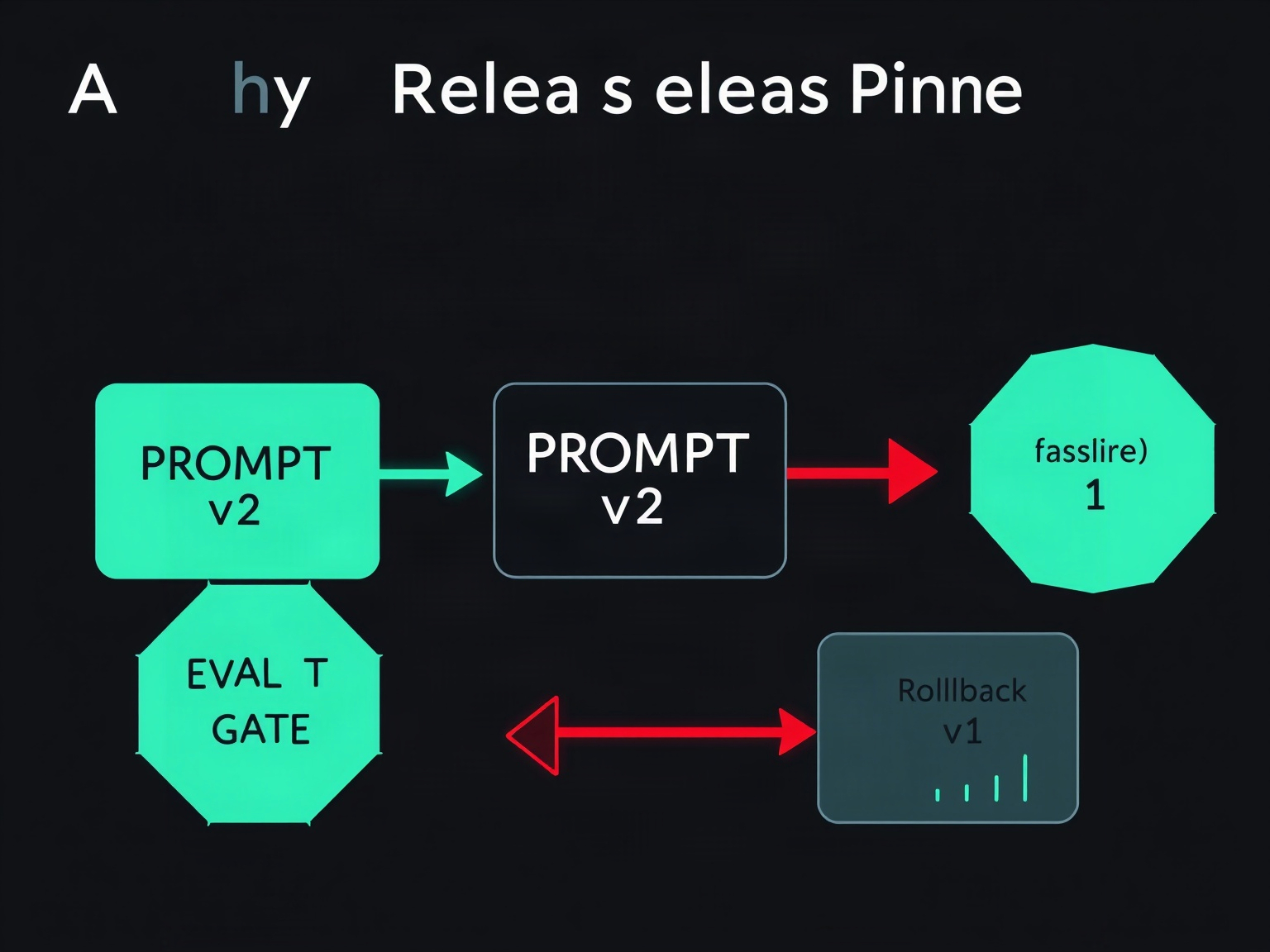
A reference rollout pipeline has six ordered steps: pass CI evals, version the artifact immutably, split a small fraction of traffic (single-digit percentages) to the candidate, score it online against the champion, expand in stages (25/50/100%) as metrics hold, and promote or roll back by repointing an alias. Every step has a measurable gate and a fast revert path.
- CI eval gate. Offline evals must pass before any deployment artifact is created, per Braintrust’s run-in-CI docs.
- Version. Register the artifact immutably with the production alias still pointing at the previous stable version, per Langfuse prompt version control.
- Router split. Send a small fraction of traffic (single-digit percentages) to the candidate via a feature flag or LiteLLM’s router.
- Shadow/online scoring. Score the challenger against the champion on live traffic, per Braintrust Evaluate and Statsig AI evals.
- Gate and expand. When online metrics meet promotion thresholds, expand in stages to 25%, 50%, then 100%.
- Promote or roll back. Repoint the alias to the new version on promotion, or to the previous version on rollback.
This pipeline works for any combination of release units. You might canary a prompt change, shadow a model swap, blue-green a tool set addition.
Progressive delivery is overkill for internal tools, low-traffic agents, or single-user prototypes. If you’re shipping to a handful of internal users and can manually inspect every output, a simple deploy-and-monitor cycle suffices. The overhead of eval gates, versioning, and traffic splitting isn’t worth it.
Progressive delivery capabilities by platform (per vendor docs)
| Capability | LangSmith | Langfuse | Braintrust | Statsig / LaunchDarkly | W&B Weave | LiteLLM | MLflow |
|---|---|---|---|---|---|---|---|
| Prompt/model versioning | Deployment runtime supports versioned agent configs; Cloud/BYOC/self-hosted | Central prompt storage with versioning; labels for environment management | Immutable experiment versions; aliases for promotion | Not documented | Immutable versions via weave.publish; :latest/:production aliases |
Not documented | Not documented |
| Percentage-based canary rollout | Not documented | Not documented | Not documented | LaunchDarkly: percentage rollouts, including sub-1% allocations; Statsig: staged ramps (2%→10%→50%→100%) | Not documented | Load-balancing across model deployments with cooldowns, fallbacks | Not documented |
| Shadow / online eval on live traffic | Online evaluations track quality on live traffic | Not documented | Online scoring on production traces; LLM-as-a-judge scorers | Statsig AI evals: online evals (Early Access) | Not documented | Not documented | Not documented |
| Offline eval gates in CI/CD | Evaluation concepts cover pre-deployment testing | Not documented | Evals run in CI; non-zero exit on failure; smoke runs on PR | Not documented | Not documented | Not documented | Evaluation-Driven Development; LLM-as-a-judge; custom scorers |
| Rollback mechanism | Not documented | Labels to manage prompt deployments across environments | Not documented | Not documented | “Roll back to previous versions if needed” via alias repoint | Not documented | Not documented |
FAQ
The questions below cover the rollout patterns practitioners ask about most: what progressive delivery means for agents, how it differs from web-service deploys, which tools gate traffic, what eval gates check, how rollback works, and when the overhead isn’t justified. Each answer is self-contained and cites the vendor documentation it draws on.
What is progressive delivery for AI agents? Progressive delivery for AI agents applies staged rollout patterns (canary, shadow, blue-green, champion-challenger) to agent release artifacts (prompts, models, tools, graph configs), using eval-based promotion gates and immutable versioning for rollback, per LangSmith’s deployment docs.
How is releasing an agent different from releasing a web service? Agent releases differ because outputs are non-deterministic, the release unit is a composite bundle (prompt + model + tools + graph), and quality evaluation is required beyond error rates, per Braintrust Evaluate and LangSmith evaluation concepts.
Can I use feature flags for prompt rollouts? Yes. LaunchDarkly and Statsig support percentage-based targeting that routes a fraction of requests to a new prompt version, per LaunchDarkly percentage rollouts and Statsig best practices, but you can also use Langfuse labels or Weave aliases plus LiteLLM routing as flag-free primitives.
What should an eval gate check before promoting a new agent version? Eval gates should check task completion rate, hallucination rate, safety filter pass rate, cost thresholds, and latency budgets, evaluated both in CI before deployment and against live traffic post-deploy, per MLflow LLM evaluation and Braintrust run-in-CI.
How do I roll back a bad agent release? Rollback uses immutable versioning plus alias repointing: the production alias is repointed to the previous version, per W&B Weave prompt versioning and Langfuse prompt version control, but client-side caching may delay the effect until caches expire.
When is progressive delivery overkill for an agent? Progressive delivery is overkill for internal tools, low-traffic agents, or single-user prototypes where manual inspection of every output is feasible and the overhead of eval gates and versioning isn’t justified, per Argo Rollouts canary strategy.
The Bottom Line
Yes: for agent systems, progressive delivery is worth the overhead. Non-deterministic outputs and composite release units make traditional deploys risky, so stage changes behind eval gates, split traffic for canaries, and keep rollback to a fast alias repoint. The patterns from web services transfer; the metrics just change.
The tooling exists today: LangSmith for the deployment runtime, Langfuse and W&B Weave for prompt versioning, LiteLLM for routing, Statsig and LaunchDarkly for gating, Braintrust and MLflow for evals, and Argo Rollouts for Kubernetes-native rollouts. Start small: canary a prompt change at a low single-digit percentage, shadow a model swap, build eval gates in CI. The patterns scale with your system’s complexity.
How This Guide Was Built
This review is based on official vendor documentation; we did not run any tools hands-on. Every capability claim is traceable to a specific docs page, verified with HTTP 200 status checks on 2026-08-27. Where a platform’s docs do not cover a capability, we state “Not documented” rather than inferring features. No fabricated statistics, benchmarks, or hands-on testing claims appear here.
Related guides
- Our agent evaluation stack guide
- Production agent error handling patterns
- MCP server production deployment patterns
- Multi-agent production orchestration