Multi-agent failure modes: 7 patterns that break production systems
Your multi-agent system works in staging. In production, it burns money, deadlocks, or quietly produces wrong answers that nobody notices until a customer complains. If that sounds familiar, you’re not alone.
Multi-agent LLM systems fail 41-86% of the time in production depending on task complexity futureagi.substack.com. Even with well-trained individual agents, end-to-end reliability degrades fast: five agents at 95% individual accuracy deliver roughly 77% overall success — and that’s before you account for coordination overhead, context loss, and unbounded loops conceptualise.de. Gartner documented a 1,445% surge in enterprise multi-agent inquiries from Q1 2024 to Q2 2025 agilesoftlabs.com, meaning thousands of teams are hitting these same walls right now.
This post covers seven failure patterns we’ve seen repeatedly in production systems, with detection signals and concrete recovery strategies for each.
Cascading errors
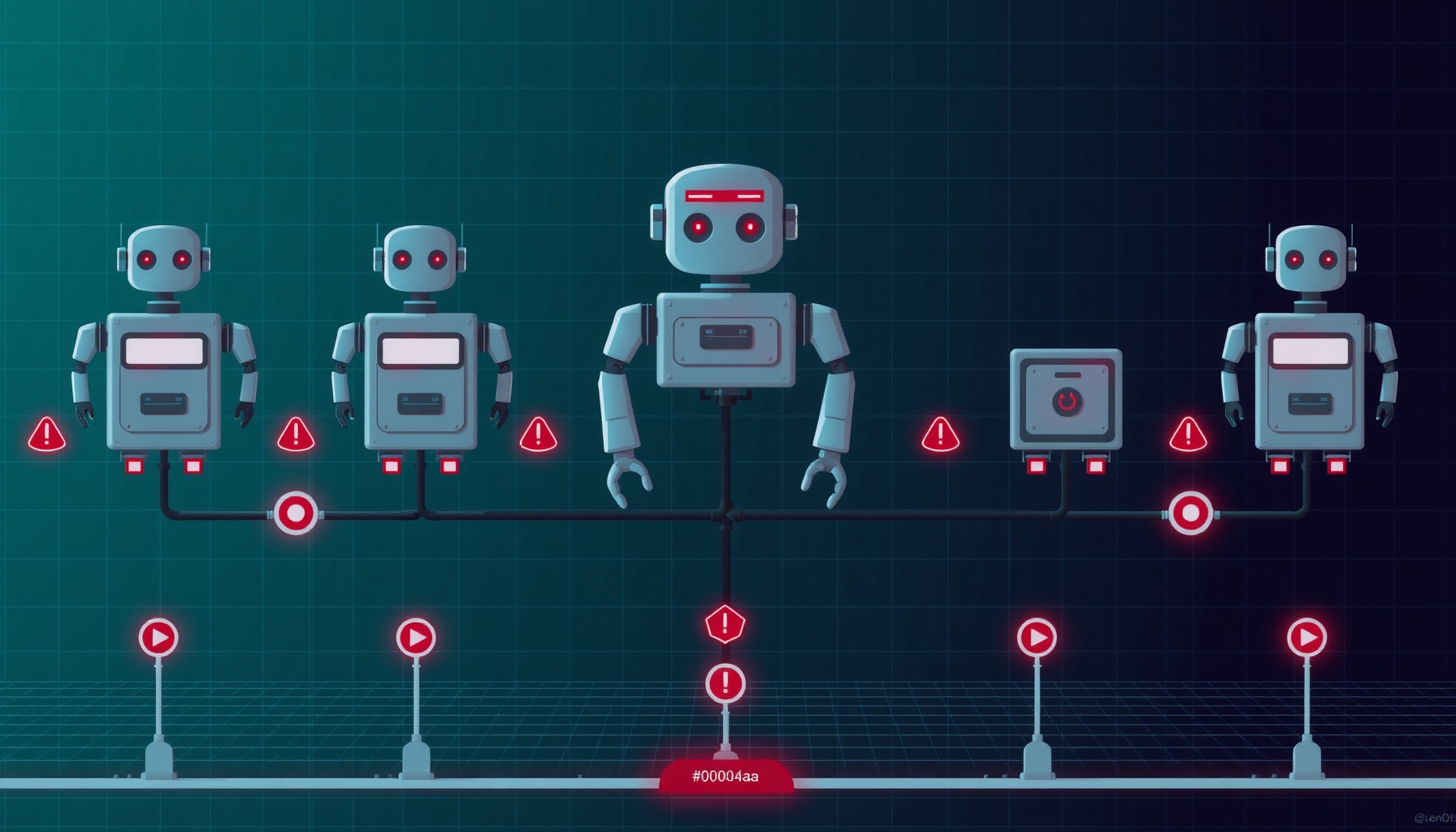
What happens. Agent A produces a slightly wrong output. Agent B treats that output as truth and compounds the error. By Agent E, the pipeline has produced a confident, coherent, completely wrong result. One bad token at step one poisons the entire chain.
Root cause. No validation at handoff boundaries. Teams treat agent-to-agent communication like in-process function calls when they should treat every boundary as a trust boundary — the same way you’d treat an external API.
Detection signal. Output quality degrades monotonically as pipeline depth increases. Quality metrics on individual agent outputs look fine, but end-to-end correctness is poor.
Recovery strategy. Insert schema validation and a verifier step at every handoff. Here’s a minimal pattern using Pydantic-style validation:
from dataclasses import dataclass, field
from typing import Any, Optional

@dataclass
class AgentHandoff:
    agent_id: str
    input_schema: type
    output_schema: type
    verifier: Optional[callable] = None
    max_retries: int = 2

def safe_handoff(agent_fn, handoff: AgentHandoff, payload: dict) -> dict:
    validated_input = handoff.input_schema(**payload)
    for attempt in range(handoff.max_retries):
        raw = agent_fn(validated_input)
        try:
            result = handoff.output_schema(**raw)
            if handoff.verifier and not handoff.verifier(result):
                raise ValueError("Verification failed")
            return result
        except (TypeError, ValueError) as e:
            if attempt == handoff.max_retries - 1:
                raise RuntimeError(f"Handoff from {handoff.agent_id} failed: {e}")
    raise RuntimeError("Unreachable")
This catches malformed outputs before they propagate and gives the upstream agent a chance to retry with correction feedback.
Coordination deadlock
What happens. Agent A waits for Agent B’s result. Agent B waits for Agent C’s result. Agent C waits for Agent A’s result. No agent makes progress, the workflow hangs, and the only signal is a timeout alarm hours later.
Root cause. Circular dependencies in the agent graph combined with no timeout configuration. Most agent frameworks default to infinite blocking reads, which works fine until someone introduces a cycle.
Detection signal. Tasks queued but never completed; monotonically increasing pending dependency counts; threads or processes blocked on I/O with no progress.
Recovery strategy. Choose an explicit orchestration topology — supervisor, sequential pipeline, or bounded directed acyclic graph — and enforce it at the framework level. Apply hard timeouts to every agent interaction:
import asyncio

async def run_agent_with_timeout(agent_fn, task, timeout_seconds=30):
    try:
        return await asyncio.wait_for(agent_fn(task), timeout=timeout_seconds)
    except asyncio.TimeoutError:
        # Log the timeout with full task context for debugging
        return {"status": "timeout", "task_id": task.id, "agent": agent_fn.__name__}
Make timeout handling part of the agent contract, not an afterthought. Every agent should clean up resources and surface a structured failure on timeout.
Context drift
What happens. A shared goal gets passed through three agents as free-text messages. The first agent says “summarize the Q3 earnings call.” The second interprets it as “extract key quotes from Q3.” The third produces a bullet list of revenue figures. Each handoff loses fidelity, like a telephone game across model calls.
Root cause. Lossy context passing via unstructured text. Human conversations tolerate ambiguity; LLM handoffs amplify it.
Detection signal. Outputs from downstream agents miss or contradict requirements that were present in the original task. Human evaluators note that “the agent lost the plot.”
Recovery strategy. Externalize shared state into a structured, canonical task object that travels with the workflow. Instead of passing a text prompt between agents, define a typed task specification:
@dataclass
class Task:
    id: str
    objective: str
    constraints: list[str] = field(default_factory=list)
    required_outputs: list[str] = field(default_factory=list)
    context: dict[str, Any] = field(default_factory=dict)
    provenance: list[str] = field(default_factory=list)
Agents read from and write to this object. The objective field is immutable — once set, no agent can rewrite it. The provenance list tracks every modification, giving you an audit trail when things go wrong.
Infinite agentic loops (cost runaway)
What happens. Two agents are asked to iteratively improve a response. Agent A critiques, Agent B refines, Agent A critiques the refinement, Agent B refines again. This continues for thousands of LLM calls in minutes, racking up API costs and producing negligible improvement after the first iteration.
Root cause. Unbounded agent-to-agent refinement cycles with no termination condition. Each agent is doing exactly what it was told — the system design is what’s broken.
Detection signal. Token usage and API costs spike without corresponding improvement in output quality metrics. IAL-Scan examined 6,549 LLM agent repositories and found 68 confirmed infinite agentic loop failures across 47 projects, with 91.9% precision . This is not a corner case — it’s a design pattern that’s being shipped to production regularly.
Recovery strategy. Enforce global budgets at every level:
@dataclass
class Budget:
    max_steps: int = 10
    max_tokens: int = 50000
    max_cost_usd: float = 0.50

class AgentLoopGuard:
    def __init__(self, budget: Budget):
        self.budget = budget
        self.step_count = 0
        self.total_tokens = 0
        self.total_cost = 0.0

    def step(self, tokens_used: int, cost: float) -> bool:
        self.step_count += 1
        self.total_tokens += tokens_used
        self.total_cost += cost
        return (
            self.step_count <= self.budget.max_steps
            and self.total_tokens <= self.budget.max_tokens
            and self.total_cost <= self.budget.max_cost_usd
        )

    def should_continue(self, improvement_score: float) -> bool:
        if not self.step(self.current_tokens(), self.current_cost()):
            return False
        # Stop if diminishing returns
        return improvement_score > 0.05
Combine hard caps with diminishing-returns detection. If the last three iterations each improved the output by less than 5%, terminate the loop.
Silent partial failure
What happens. A four-agent pipeline completes with a well-written final answer. The dashboard shows green checkmarks across every agent. The problem: the third agent’s web search tool returned a 503 error, which it logged, but the orchestration code only checked the final output, not intermediate failures. The answer was built on empty data and presented confidently.
Root cause. No end-to-end evaluation. Dashboards check per-agent status codes — “did the agent finish?” — instead of output quality — “is the output correct and complete?”
Detection signal. User-reported errors that don’t correlate with system metrics. Post-hoc analysis reveals intermediate agents that logged errors but whose failure was masked by successful downstream completions.
Recovery strategy. Implement output evaluation gates at every handoff, not just status checks. Score outputs on confidence, groundedness against source data, and completeness relative to the task requirements:
@dataclass
class AgentOutput:
    content: Any
    confidence: float
    grounded: bool
    sources: list[str]
    errors: list[str]

def evaluate_output(output: AgentOutput, task: Task) -> bool:
    if not output.grounded:
        return False
    if output.confidence < 0.4:
        return False
    if output.errors:
        return False
    return True
Score outputs, not just success codes. A pipeline that reports 100% completion but delivers low-confidence content is worse than one that fails loudly and early.
Inter-agent misalignment
What happens. Agent A is asked to “find relevant documents.” It returns 50 results, prioritizing recency. Agent B expects 3-5 highly relevant results and interprets the volume as noise. The two agents have different implicit definitions of “relevant” and different expectations about output shape, and nobody told them to agree.
Root cause. Specification and design failures upstream of the code. Teams define agent roles in natural language during planning, then those vague descriptions get translated into system prompts that encode different assumptions.
Detection signal. Agents consistently reject or ignore each other’s outputs. Upstream agents produce outputs that downstream agents can’t parse. Human reviewers see contradictory behavior that reflects conflicting role interpretations.
Recovery strategy. Define explicit output contracts and role boundaries before writing a single prompt. The MAST taxonomy identifies 14 failure modes across 3 categories from 1600+ annotated traces (inter-rater agreement kappa=0.88) . Use a structured evaluation framework to catch misalignment early:
- Write a formal role description: “Agent Ranks documents by relevance score [0,1] based on keyword overlap with the query. Returns top 5 results sorted descending.”
- Define output contracts with required fields, types, and acceptable value ranges.
- Run alignment tests before full integration — pass known inputs between agents and verify the outputs match expectations.
Tool and data corruption
What happens. An agent calls a real-time data API and gets stale or manipulated data. Another agent has a plugin that exposes a shell command — someone exploits it through prompt injection. The agent faithfully reports what the tool gave it, and the system acts on poisoned information.
Root cause. Untrusted tool boundaries. Agents in production connect to databases, APIs, file systems, and sometimes shell environments. Each connection is an attack surface that traditional circuit breakers and retry logic were not designed to handle — they were built for stateless microservices, not agents with context and tool access galileo.ai.
Detection signal. Outputs that contradict known ground truth. Tool calls returning unexpected schemas or data volumes. Response patterns consistent with prompt injection (sudden topic shifts, hallucinated provenance).
Recovery strategy. Apply the Model Context Protocol (MCP) with strict validation at every tool boundary. Least-privilege scoping — an agent that only needs to read from one database table should not have access to the shell. Validate tool outputs against expected schemas before they enter the agent’s context window:
@dataclass
class ToolBoundary:
    allowed_tools: list[str]
    output_validators: dict[str, callable]
    max_result_size_bytes: int = 1024 * 100  # 100KB

def validate_tool_call(
    tool_name: str,
    result: Any,
    boundary: ToolBoundary
) -> Any:
    if tool_name not in boundary.allowed_tools:
        raise PermissionError(f"Tool {tool_name} not allowed")
    if tool_name in boundary.output_validators:
        result = boundary.output_validators[tool_name](result)
    return result
Why traditional recovery patterns fall short
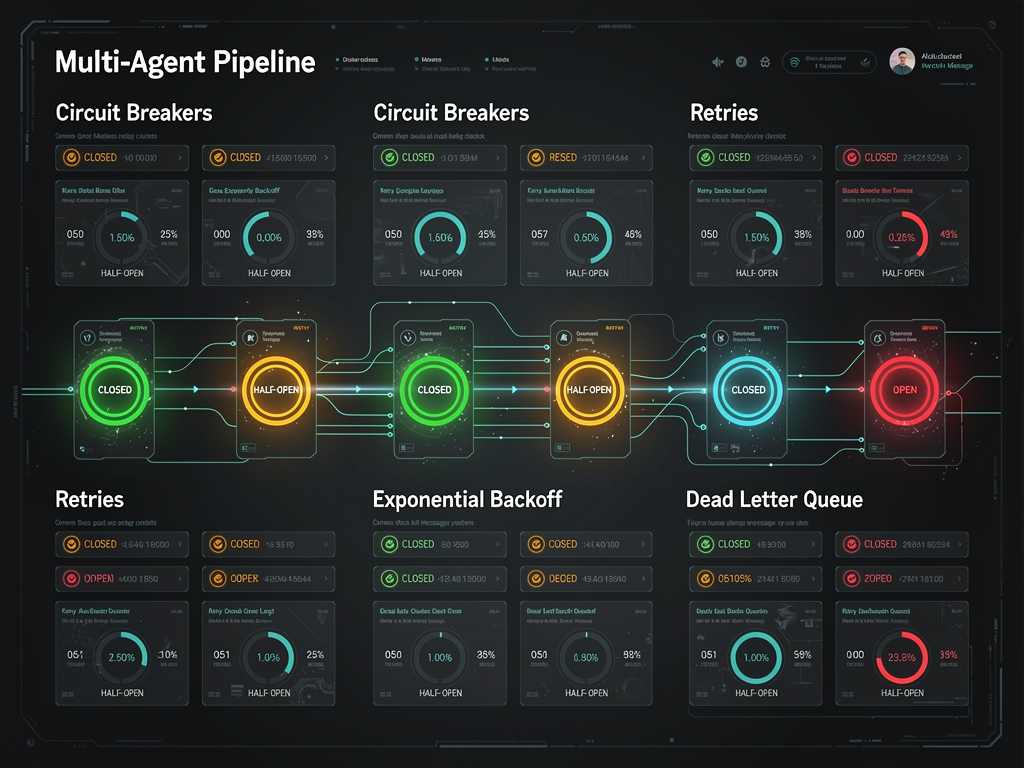
Circuit breakers, retry with exponential backoff, and bulkhead isolation work well for stateless microservices. They fail for multi-agent systems because agents carry state and context across calls galileo.ai. Retrying a failed agent call doesn’t help if the context was corrupted. A circuit breaker that cuts off an agent mid-conversation leaves the system in an inconsistent state. Recovery must be context-aware: log the full state on failure, route around the failed agent, and reconstruct enough context for the replacement.
Design checklist for production
- Justify every agent. If a task can be done with a single prompt, don’t split it across agents. Every handoff is a failure point.
- Choose an explicit topology. Supervisor, sequential pipeline, or bounded DAG. Don’t let the framework default to a fully-connected mesh.
- Make every boundary a trust boundary. Validate inputs and outputs at every handoff.
- Set hard budgets. Step limits, token caps, cost ceilings. Test them in staging.
- Evaluate continuously. Score outputs, not just com](https://galileo.ai/blog/multi-agent-ai-system-failure-recovery) https://galileo.ai/blog/multi-agent-ai-system-failure-recovery futureagi.substack.com https://futureagi.substack.com/p/why-do-multi-agent-llm-systems-fail getmaxim.ai https://www.getmaxim.ai/articles/multi-agent-system-reliability-failure-patterns-root-causes-and-production-validation-strategies/ simorconsulting.com https://simorconsulting.com/blog/multi-agent-failure-modes-what-breaks-when-agents-call-agents/ agilesoftlabs.com https://www.agilesoftlabs.com/blog/2026/03/multi-agent-ai-systems-enterprise-guide
📖 Related Reads
- CodeIntel Log — code quality, debugging, and software engineering benchmarks
- ToolBrain — tool reviews, LLM comparisons, and AI workflow guides
Cross-links automatically generated from NiteAgent.
← Back to all posts