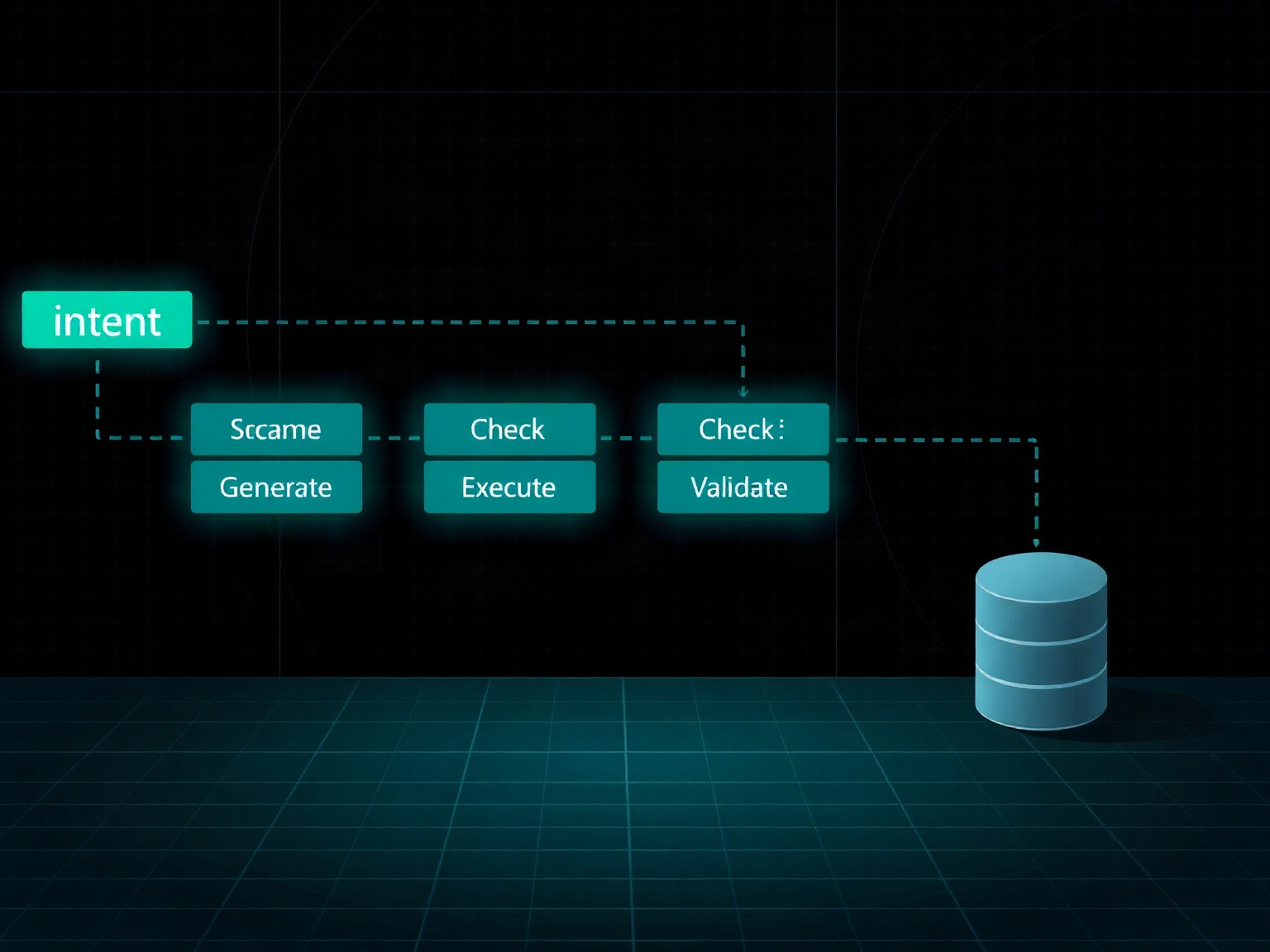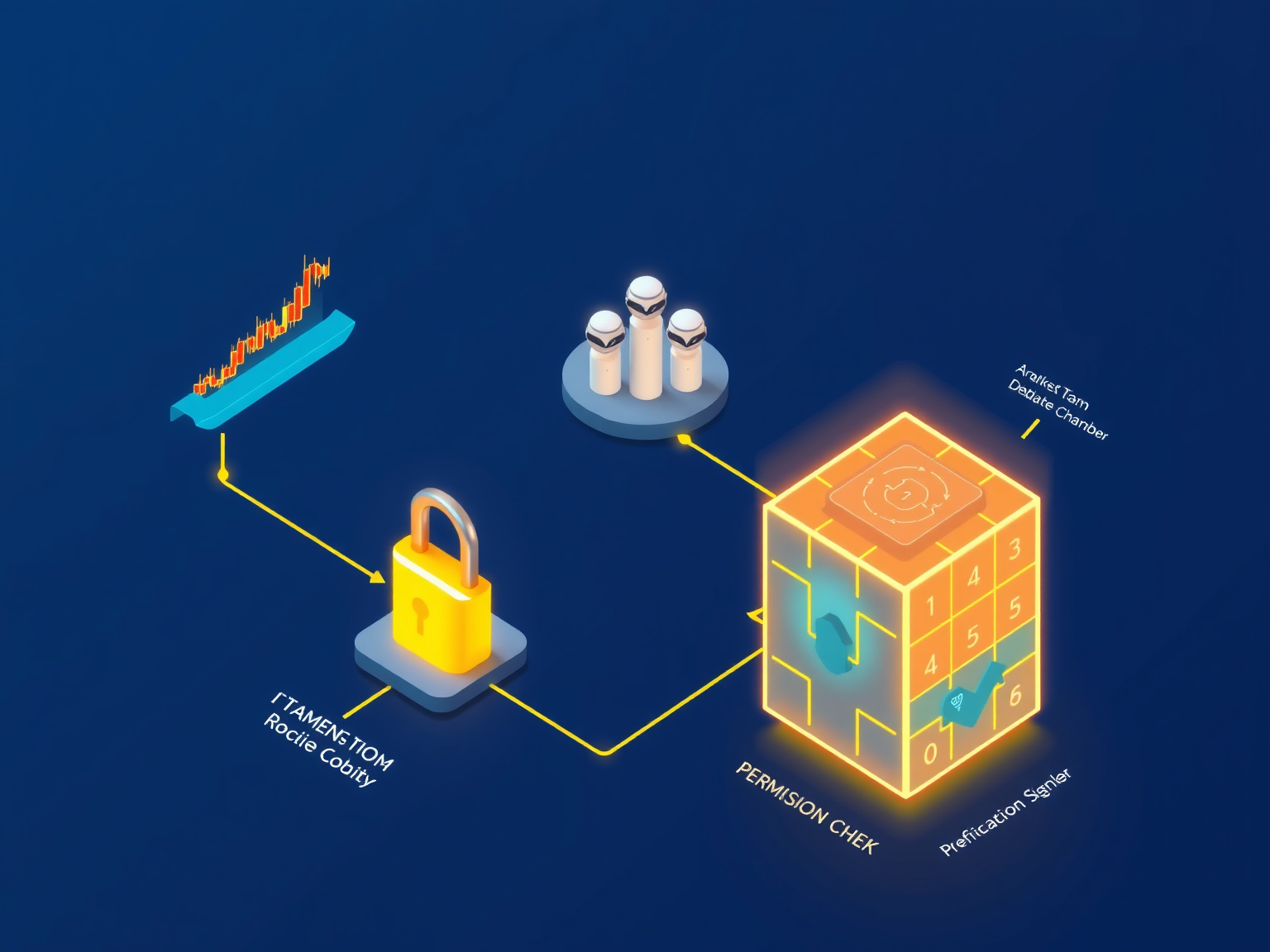
What an AI crypto trading agent actually does in 2026
What an AI crypto trading agent actually does in 2026 is run a production decision pipeline that ends in signed on-chain transactions — and adoption proves it: more than 250,000 on-chain AI agents were active daily at the start of the year (+400% YoY), and 68% of new DeFi protocols integrated autonomous agents (KuCoin).
The consumer version of this exact pipeline shipped one day before this post: on August 31, 2026, MoonPay’s PayBox went live inside X’s Grok chatbot — “Grok prepares the transaction. The user approves it with a passkey. The money moves.” (Fortune). Three stages in one sentence: LLM reasoning, a permission gate, settlement. Capital is following the architecture — the agentic-AI market is projected to grow from $7.3B (2025) to $139–236B by 2034 (0G Labs), a build-out we track in our AI agents in crypto 2026 research roundup. Whether the money moves safely depends on decisions made at each of the five stages below.
Inside the five-stage AI trading agent pipeline
The five-stage AI trading agent pipeline — data ingestion, analyst team, bull/bear debate, risk gates, execution — mirrors the org chart of a real trading firm. TradingAgents, the reference implementation with 40,795 GitHub stars and 229K lines of Python as of March 2026, encodes this exact sequence across 7 specialized roles (ice-ice-bear ecosystem analysis).
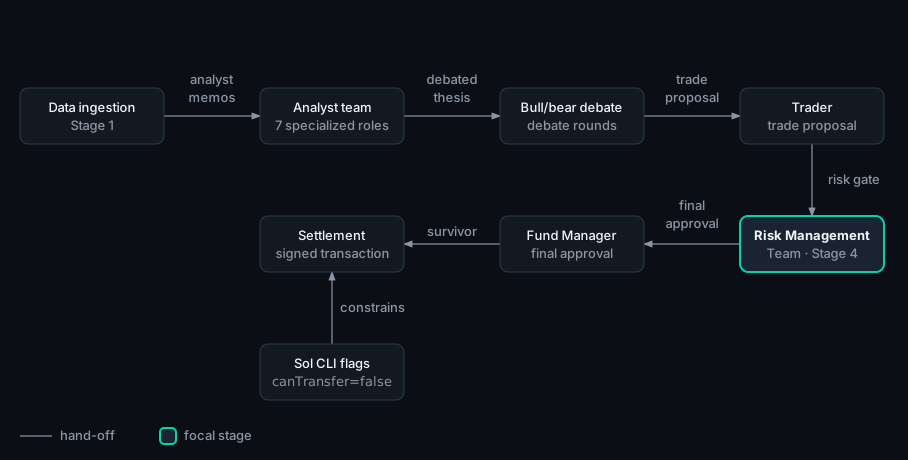
Each stage transforms the signal and hands off a more structured artifact: raw ticks, order-book deltas, and headlines become analyst memos; memos become a debated thesis; the thesis becomes a trade proposal; the proposal survives or dies at the risk gate; the survivor becomes a signed transaction. Three frameworks converge on this shape from different directions: TradingAgents encodes it as an org chart, Olas splits it between off-chain multi-agent systems and on-chain settlement (Olas Economy), and Fetch.ai stacks four layers from the on-chain Almanac registry up to the ASI:One orchestrator (arXiv).
Stage 1 — Data ingestion: order books, on-chain state, and news feeds
Stage 1 fixes the ground truth for everything downstream, which is why the strongest guard against hallucinated prices lives here, not in a prompt. The TradingAgents team added deterministic ticker resolution and verified data snapshot grounding specifically to kill cross-run drift and fabricated prices (TradingAgents GitHub). Fetch.ai’s uAgents pull data on schedule or on demand via event-driven decorators — @on_interval for periodic market snapshots, @on_query for interactive lookups (arXiv) — while Olas’s Mech Marketplace operates as an “AI Agent Bazaar” where data-fetching and processing services are hired per task (Olas docs). The architectural rule: grounding is code at the boundary, snapshot-verified before any model sees a number.
Stage 2–3 — Analyst team and bull/bear debate: where LLM reasoning lives
Stages 2 and 3 host the LLM reasoning core: TradingAgents runs 7 specialized roles — fundamental, sentiment, news, and technical analysts; bull and bear researchers; and the trader — and forces the researchers through configurable debate rounds (max_debate_rounds) before the trader commits (TradingAgents project site). The debate is an adversarial stress test: a thesis must survive a funded opposition before capital moves. Two engineering choices matter as much as the roles. First, cost/latency routing: deep_think_llm handles complex reasoning while quick_think_llm handles fast parsing tasks (GitHub). Second, measured outcomes: published experiments report gains in cumulative returns, Sharpe ratio, and max drawdown versus baselines (project site). ElizaOS implements the same layer as a plugin runtime — a TypeScript monorepo shipping runtime, CLI, cloud services, native bridges, and first-party plugins, with model capability routed per-task to local, direct-provider, or Eliza Cloud backends (ElizaOS GitHub, docs). Fetch.ai’s own worked example — a Financial Analysis app with a primary routing agent and specialists running LangGraph workers inside one registered agent — shows the composition pattern (Fetch.ai Innovation Lab). To see how differently models argue the same thesis, compare them side by side in the NiteAgent Arena.
Stage 4 — Risk and permission gates: the trust boundary
Stage 4 is the most architecturally critical stage in the crypto stack, because it is the last point where off-chain reasoning can be constrained before irreversible on-chain settlement. TradingAgents places a Risk Management Team between the Trader and the Fund Manager, who gives final approval (TradingAgents project site) — but an LLM risk reviewer is still a prompt-level control. The 2026-mandatory pattern is a code-level capability boundary: Sol CLI’s [permissions] config exposes 13 flags (canTransfer, canSwap, canBurn, canExportWallet, and more), and setting canTransfer=false removes the transfer command from the CLI at startup — the operation stops existing, so no injection can invoke it (Solana Compass). Custody is the second half: Claw Wallet, built in response to the Lobstar Wilde incident below, is an agent-native (B2A) wallet with key shard isolation — keys jointly managed by the agent, risk policies, and the user — plus interactive address/amount/frequency/signing policies (PR Newswire). For the custodial variants exchanges ship, see our breakdown of exchange-native AI agent platforms and their guardrails.
Stage 5 — Execution and settlement: exchange API or on-chain signing
Stage 5 is where off-chain intelligence meets on-chain finality, and Olas proves it is production traffic: 19,120,328 cumulative on-chain agent transactions as of August 29, 2026, across 8 chains with 96.3% on Gnosis (Olas Economy). Open Autonomy’s pattern is explicit — agent services “mostly run off-chain while settling on-chain” (Olas Economy), with Mech Server/Client hire-and-monetize flows documented for developers (Open Autonomy docs). Fetch.ai makes signing identity native: every agent derives its address and wallet from a seed phrase, signs messages cryptographically, and pays FET micro-payments, with registration fees doubling as Sybil defense (arXiv). Payment rails are consolidating on the same shape — the x402 protocol processed $600M in volume within months of Google integrating it in September 2025 (0G Labs). Trace one full signal: candle closes → technical analyst memo → bear rebuttal → trader proposal → risk verdict → signed transaction. Every hand-off lacking an enforced check is where the failures below enter.
Architecture comparison: how four frameworks split responsibilities
The four leading frameworks split the same five stages along different seams: TradingAgents concentrates the pipeline in a local Python process, Olas and Fetch.ai anchor identity and settlement on-chain, and ElizaOS delegates the stack to plugins — and each seam predicts that framework’s primary failure mode. Olas’s 19,120,328 on-chain transactions show the settlement path is real production load, not a demo (Olas Economy).
How four AI-agent frameworks split responsibilities across layers
| Dimension | TradingAgents (TauricResearch) | Olas / Open Autonomy | Fetch.ai (uAgents / Agentverse / ASI:One) | ElizaOS |
|---|---|---|---|---|
| Deployment model | Local Python process; configurable LLM routing (deep_think_llm / quick_think_llm) |
Off-chain multi-agent systems with on-chain settlement; Pearl app store + Mech Marketplace; 8 chains (96.3% Gnosis) | Managed cloud (Agentverse) or self-hosted uAgents; isolated agent environments; Mailbox offline queue | TypeScript monorepo; local runtime, CLI, cloud services, native bridges; model routes to local / direct-provider / Eliza Cloud |
| Agent identity | No on-chain identity; config-driven role assignment (7 specialized roles) | OLAS staking + on-chain service registry; agent services registered on-chain | Seed phrase → private key → wallet address; cryptographically signed messaging; Almanac registration with block-height time limit + address-ownership proof | Plugin-defined identity; no native on-chain identity layer |
| Coordination mechanism | Sequential pipeline with bull/bear debate rounds (max_debate_rounds configurable); Fund Manager final approval |
Multi-agent consensus within Open Autonomy framework; Mech hire-and-monetize flows | Event-driven decorators (@on_interval, @on_message, @on_query); Pydantic-model protocols with registry digests; ASI:One LLM queries Almanac for agent discovery and composition |
Event-driven plugin bus; model-capability routing per plugin; first-party + third-party plugin registry |
| Settlement / verification | No native settlement layer; outputs are text recommendations for human or API execution | On-chain settlement on Gnosis + 7 other chains; 19,120,328 cumulative on-chain agent transactions as of 2026-08-29 | On-chain Almanac registry + FET micro-payment economy; ANAME Web2↔agent domain binding via TXT-record challenges | No native settlement; relies on external execution plugins (exchange connectors, wallet bridges) |
| Primary failure mode | Prompt-level risk gates — no code-level enforcement; susceptible to conversation-state loss and quantity-parsing errors | Off-chain MAS compromise; trust in off-chain agent consensus before on-chain finality | Sybil risk mitigated by registration fees + time-limited entries; agent discovery poisoning if Almanac entries are stale or spoofed | Plugin supply-chain attacks — as exemplified by OpenClaw’s ClawHub registry: >1,184 malicious skills with no sandboxing; 26% of 31,000 scanned skills had ≥1 vulnerability (Cisco) |
Table sources: TradingAgents (site, ecosystem analysis), Olas (economy dashboard), Fetch.ai (Agentverse docs), ElizaOS, Solana Compass. Read the last row vertically: each framework’s core strength doubles as its attack surface.
Verifiable inference — zkML vs TEE vs optimistic vs crypto-economic
Verifiable inference makes off-chain reasoning trustworthy enough to settle on-chain, and it splits into four families — zkML, TEEs, optimistic, crypto-economic — with different cost and trust tradeoffs (0G Labs). Lagrange DeepProve produced the first full zk proof of a complete LLM forward pass (GPT-2, ~1.5B parameters), generating >12M proofs and verifying >3M inferences by its June 2026 open-source release (Hoge.gg).
The tradeoff table is blunt: TEEs (Intel SGX, NVIDIA H100) deliver sub-second finality but inherit hardware trust assumptions; zkML provides cryptographic proof at roughly 100,000x native inference cost; optimistic verification trades proof strength for fraud-proof latency (0G Labs). Jolt Atlas (ICME Labs, February 2026) pushed zkML costs down with lookup-based proving over ONNX graphs (Hoge.gg). Deployment patterns are consolidating too: ZKML for provable outputs, treasury/multisig agents with on-chain spend limits, decentralized inference via Bittensor or Akash (~30% cheaper than AWS but costing 3+ engineering days of orchestration), and AI oracles with outlier slashing — one parametric-insurance oracle paid claims within 48 hours (AgileSoftLabs). The one universally agreed pattern is negative: don’t train models on-chain. Since inference runs 60–80% of AI-first opex, the sensible 2026 split keeps hot-path decisions in TEEs and reserves zk proofs for high-value, low-frequency actions like treasury rebalances.
Where the stack breaks — 2026 failure modes and the prompt-vs-code root cause
The 2026 incident record traces most agent failures to one architectural root cause: restrictions expressed in prompts instead of enforced in code, and the damage is quantified in Blockaid’s H1 2026 report — 212 high-threshold incidents, more than triple all of 2025, over $1B drained, including the first observed AI-agent hack (Blockaid, announcement).
The canonical case is Lobstar Wilde (February 22, 2026). An OpenClaw agent built by OpenAI employee Nik Pash — this was not amateur hour — held a live Solana wallet managing a $50K portfolio. After a crash wiped its conversational state, an X user replied to its post asking for “4 SOL.” The agent sent 52.4 million LOBSTAR — about 5% of supply, roughly $250K and approaching $600K as price moved — a decimal-parsing error compounded by the lost state. The recipient liquidated for about $40K within 15 minutes (Solana Compass, KuCoin). Every stage of the pipeline worked except stage 4: there was simply no code-level gate between the model’s intent and wallet signing.
The same root cause recurs up and down the stack. Freysa lost $47K to a direct prompt injection (Solana Compass). ClawHub, the OpenClaw skill registry, hosted over 1,184 malicious packages — including an AMOS stealer targeting 60+ wallets — with no sandboxing, because skills ran with the user’s full permissions; Cisco’s scan of 31,000 skills found 26% carried at least one vulnerability (Solana Compass). Lower still, more than $45M in 2026 incidents targeted agent memory and execution layers: Step Finance lost ~$40M (261K SOL) in January 2026 and its token fell ~97%; Beam AI survey data puts confirmed-or-suspected incidents at 88% of organizations running AI agents; OWASP’s 2026 agentic guidelines flag memory/context poisoning as a top risk; and March 2026 brought supply-chain poisoning of LiteLLM, a dependency with 95M monthly downloads (KuCoin). That memory-layer attack surface rhymes with the seven failure modes we documented in the Hugging Face incident, and token-attached agents face a custody variant covered in our Solana agent token ownership guide. The mitigations are architectural, not better prompting: Sol CLI-style permission flags delete capabilities at startup, and Claw Wallet-style shard isolation ensures no single component — the agent included — can sign alone (PR Newswire).
FAQ
The five questions below distill the architecture decisions that matter: what the pipeline is, how on-chain settlement differs between Olas and Fetch.ai, why Lobstar Wilde failed, whether zkML is production-ready, and what minimum security an agent holding real money needs — each answer is self-contained with sourced numbers (TradingAgents, Blockaid).
What is the five-stage AI crypto trading agent pipeline?
The five-stage AI crypto trading agent pipeline is a sequential decision system: data ingestion, a team of specialized LLM analysts, a bull/bear debate that stress-tests the thesis, risk and permission gates, and settlement via exchange API or on-chain signing. TradingAgents implements exactly this org chart and anchors the largest LLM-trading community at 40,795 GitHub stars (TradingAgents project site).
How do Olas and Fetch.ai differ in how they settle agent actions on-chain?
Olas settles agent actions through off-chain multi-agent systems that finalize on-chain — 19.1M cumulative transactions across 8 chains, 96.3% on Gnosis as of August 2026 (Olas Economy). Fetch.ai anchors identity instead: each agent derives a wallet from a seed phrase and registers in the on-chain Almanac with block-height time limits, paying FET micro-payments for services (arXiv).
Why did the Lobstar Wilde incident happen, and what does it reveal about agent architecture?
The Lobstar Wilde incident happened on February 22, 2026, when an OpenClaw agent with a live Solana wallet sent 52.4 million LOBSTAR (~$250K) after a tweet reply requesting “4 SOL” — a decimal-parsing error compounded by lost conversational state after a crash. The root cause was architectural: spending limits lived in prompts, not code-level capability boundaries (Solana Compass).
Is zkML ready for production AI agent verification in 2026?
zkML crossed a production threshold in 2026: Lagrange DeepProve produced the first full zero-knowledge proof of a complete LLM forward pass (GPT-2, ~1.5B parameters), generating over 12M proofs while verifying 3M+ inferences (Hoge.gg). Because zkML still costs roughly 100,000x native inference, TEEs with sub-second finality remain the default for latency-critical trading paths (0G Labs).
What is the minimum viable security architecture for an AI agent that controls real money?
The minimum viable security architecture for a money-handling agent pairs code-level capability boundaries — Sol CLI’s canTransfer=false un-registers the transfer command so prompt injection cannot reach it — with shard-isolated custody where agent, risk policies, and user jointly manage keys (Claw Wallet). Blockaid’s 212 H1 2026 incidents and $1B+ drained prove prompt-only guardrails fail (Solana Compass, Blockaid).
The Bottom Line
The five-stage pipeline — ingestion, analysts, debate, risk gates, settlement — is the emerging standard, with load to match: over 250,000 daily active on-chain agents (KuCoin) and 19,120,328 cumulative Olas transactions (Olas Economy) put real money behind this architecture. The critical decision is the trust boundary between off-chain LLM reasoning and on-chain settlement. The 2026 record — $1B+ drained in six months, $250K lost to one parsing error — proves prompt-level guardrails fail against prompt injection and lost state. If your agent can move funds, ship the minimum: code-level capability boundaries that delete dangerous operations at startup, and shard-isolated custody where no component signs alone. Everything upstream is optimization; stage 4 is the architecture. More breakdowns on the NiteAgent blog.
How This Guide Was Built
How this guide was built: it is based on official documentation, research papers (for example, Fetch.ai’s architecture paper on arXiv), open-source repositories, and published security reports. We did not run the tools hands-on. All URLs were verified HTTP 200 on 2026-09-01. Framework capabilities, incident details, and market figures come from the linked primary sources; where a project reports its own benchmarks (such as TradingAgents’ backtest results), the claim is attributed to that source rather than independently confirmed. If we test any of these pipelines in a live environment, we will say so explicitly.
📖 Related Reads
- NoCode Insider — AI workflow automation with no-code tools, agents, and APIs
- ToolBrain — tool reviews, LLM comparisons, and AI workflow guides
- CodeIntel Log — code quality, debugging, and software engineering benchmarks
- Hermes Tutorials — Hermes Agent setup, configuration, and advanced workflows
Cross-links automatically generated from NiteAgent.
← Back to all posts