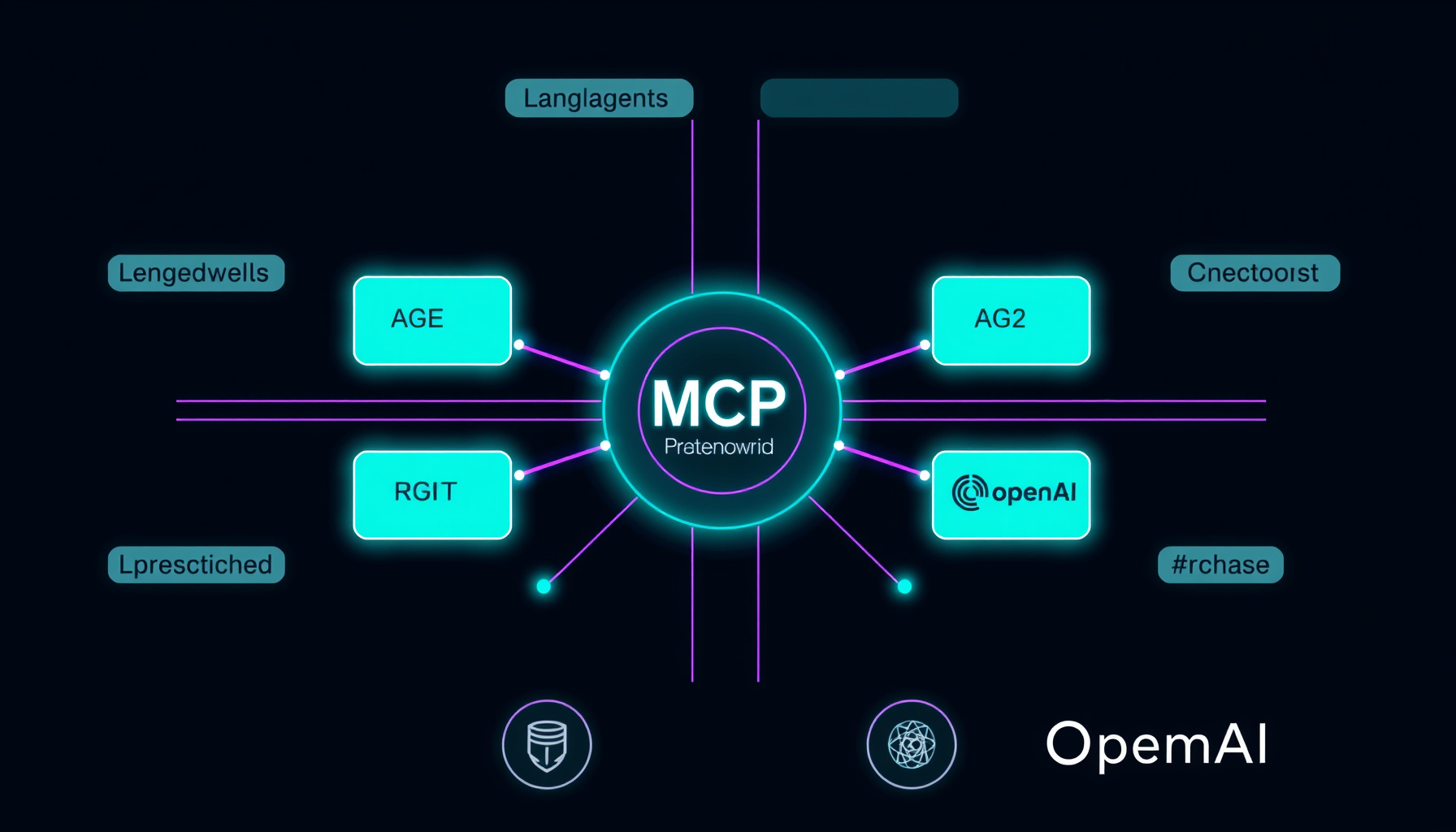
The Model Context Protocol (MCP), introduced by Anthropic in November 2024, standardizes how AI agents connect to external tools and data sources Anthropic, Introducing the Model Context Protocol, Nov 2024.. By mid-2026, every major agent framework has added native or first-class MCP support — but the integration surface looks different in each one. This guide covers framework-by-framework patterns for wiring MCP into production systems.
Read on for the integration details, or jump to the Key Takeaways for the condensed version.
Why MCP Matters for Framework Choice
Before MCP, every framework had its own tool adapter layer. Switching frameworks meant rewriting all your tool integrations. MCP decouples tools from frameworks: build an MCP server once, connect it to any MCP-compatible agent. As one analysis by Uvik Software notes, “MCP can swap LangGraph for Microsoft Agent Framework without rebuilding their integration layer” Uvik Software, Agentic AI Frameworks 2026.. LangChain’s 2026 framework overview lists “Native MCP (Model Context Protocol) support in core; A2A (Agent2Agent) support via the separate agent-framework-a2a” as a key differentiator LangChain, The best AI agent frameworks in 2026, Jun 2026..
Framework Integration Patterns
CrewAI — MCP Tools Adapter
CrewAI added MCP support via crewai-tools in v3.4 (April 2026). Crews connect to MCP servers through the MCPServerTool adapter, which wraps any MCP server’s tool list into CrewAI’s tool interface.
from crewai import Agent, Task, Crew
from crewai_tools import MCPServerTool

# Connect to an MCP server via SSE or stdio
mcp_tool = MCPServerTool(
    server_url="http://localhost:8080/mcp",
    transport="sse"
)

analyst = Agent(
    role="Data Analyst",
    goal="Query databases using MCP tools",
    tools=[mcp_tool]
)
CrewAI’s token overhead (~18% vs LangGraph for role-based prompts Alice Labs, AI Agent Frameworks 2026: Production-Tested Ranking,…) applies to MCP tools too — each tool invocation includes the agent’s role/backstory context. For high-throughput MCP calls, prefer LangGraph’s direct tool dispatch.
LangGraph — Native MCP Nodes
LangGraph offers the leanest MCP integration. MCP tools are first-class citizens in the graph node system, dispatched directly without wrapper overhead LangChain, The best AI agent frameworks in 2026, Jun 2026..
from langgraph.graph import StateGraph
from langgraph.prebuilt import ToolNode
from mcp import Client

mcp_client = Client("http://localhost:8080/mcp")
tools = await mcp_client.list_tools()

tool_node = ToolNode(tools=tools)
graph.add_node("tools", tool_node)
LangGraph’s MCP support goes deeper than other frameworks — it supports MCP resource subscriptions (real-time data streams) and prompt templates served through the protocol, not just tool calls.
AG2 — Conversational MCP Integration
AG2 (the community AutoGen fork, 42K stars) integrates MCP through its assistant agent’s tool-use system. Each MCP server maps to an agent’s function list, discoverable at runtime AtNoForgrenAI, 10 AI Agent Frameworks You Should Know in 2026, Ap….
import autogen
from autogen.mcp import MCPAgent

mcp_agent = MCPAgent(
    name="db_agent",
    mcp_servers=["http://localhost:8080/mcp"],
    llm_config={"config_list": [{"model": "gpt-4o"}]}
)
AG2’s conversational model means MCP tool calls flow through the agent’s reply chain — each tool response feeds back into the dialogue loop. This works well for research/analysis workflows but adds latency for pure data-fetch tasks.
Smolagents — Code-Action MCP
Hugging Face’s Smolagents takes a minimalist approach. MCP tools are imported as Python code blocks that the agent writes and executes inline AtNoForgrenAI, 10 AI Agent Frameworks You Should Know in 2026, Ap…. The framework’s code-in-action paradigm means MCP servers appear as importable modules.
from smolagents import CodeAgent, HfApiModel
from smolagents.mcp import MCPTool

agent = CodeAgent(
    tools=[MCPTool("mcp_server")],
    model=HfApiModel()
)
agent.run("Query the database for last month's sales")
Smolagents’ strength is rapid prototyping — zero boilerplate to get an MCP-connected agent running. Production concerns (rate limiting, retry logic) need manual handling.
OpenAI Agents SDK — MCP via Hosted Tools
OpenAI’s Agents SDK takes a different approach: MCP servers run on OpenAI’s infrastructure as hosted tools, accessed via the SDK’s tool registry OpenAI, Agents SDK Documentation, 2026..
from agents_sdk import Agent, ToolRegistry

registry = ToolRegistry()
registry.register_mcp("http://localhost:8080/mcp")

agent = Agent(
    instructions="Use the registered MCP tools",
    tool_registry=registry
)
This removes infrastructure burden but introduces vendor lock-in — your MCP servers must be reachable from OpenAI’s network.
MCP + A2A: The Two-Layer Hybrid
Most production systems in 2026 run a hybrid stack: MCP for tool access, A2A for agent-to-agent communication Google, Agent-to-Agent (A2A) Protocol at Google I/O 2026.. Frameworks that support both protocols natively (LangGraph, CrewAI) can route all external tool calls through MCP while using A2A for inter-agent delegation — keeping the protocol layers cleanly separated.
| Framework | MCP Support | A2A Support | Best For |
|---|---|---|---|
| LangGraph | Native (core) | Plugin | Production graphs, streaming |
| CrewAI | via crewai-tools | Planned | Role-based teams |
| AG2 | via autogen.mcp | Community | Conversational research |
| Smolagents | via smolagents | None | Prototyping, experimentation |
| OpenAI SDK | Hosted registry | Native | Cloud-native deployments |
Key Takeaways
- MCP decouples tools from frameworks — one MCP server works with CrewAI, LangGraph, AG2, or any MCP-compatible agent. Build tools once, reuse everywhere Uvik Software, Agentic AI Frameworks 2026..
- LangGraph has the deepest MCP integration — native support for tool calls, resource subscriptions, and prompt templates LangChain, The best AI agent frameworks in 2026, Jun 2026..
- CrewAI’s MCP adapter is production-ready but carries the same token overhead as its role-based architecture Alice Labs, AI Agent Frameworks 2026: Production-Tested Ranking,….
- AG2 and Smolagents offer lightweight MCP with less boilerplate but fewer production guardrails AtNoForgrenAI, 10 AI Agent Frameworks You Should Know in 2026, Ap….
- Hybrid MCP + A2A stacks are the production standard — MCP for tools, A2A for agent delegation Google, Agent-to-Agent (A2A) Protocol at Google I/O 2026..
- Start with one MCP server — connect a database or API as a proof of concept, then scale to multi-server topologies.
The framework landscape is converging on MCP as the universal tool layer. If you’re choosing a new agent framework in 2026, MCP-native support should be a core criterion — not a bolted-on afterthought.
Anthropic, Introducing the Model Context Protocol, Nov 2024. Anthropic, “Introducing the Model Context Protocol,” Nov 2024. https://www.anthropic.com/news/model-context-protocol Uvik Software, Agentic AI Frameworks 2026. Uvik Software, “Agentic AI Frameworks 2026.” https://uvik.net/blog/agentic-ai-frameworks/ LangChain, The best AI agent frameworks in 2026, Jun 2026. LangChain, “The best AI agent frameworks in 2026,” Jun 2026. https://www.langchain.com/resources/ai-agent-frameworks Alice Labs, AI Agent Frameworks 2026: Production-Tested Ranking,… Alice Labs, “AI Agent Frameworks 2026: Production-Tested Ranking,” Jul 2026. https://alicelabs.ai/en/insights/best-ai-agent-frameworks-2026 AtNoForgrenAI, 10 AI Agent Frameworks You Should Know in 2026, Ap… AtNoForgrenAI, “10 AI Agent Frameworks You Should Know in 2026,” Apr 2026. https://medium.com/@atnoforgenai/10-ai-agent-frameworks-you-should-know-in-2026-langgraph-crewai-autogen-more-2e0be4055556 OpenAI, Agents SDK Documentation, 2026. OpenAI, “Agents SDK Documentation,” 2026. https://platform.openai.com/docs/guides/agents-sdk Google, Agent-to-Agent (A2A) Protocol at Google I/O 2026. Google, “Agent-to-Agent (A2A) Protocol at Google I/O 2026.” https://io.google/2026
📖 Related Reads
- ToolBrain — tool reviews, LLM comparisons, and AI workflow guides
- Hermes Tutorials — Hermes Agent setup, configuration, and advanced workflows
Cross-links automatically generated from NiteAgent.
← Back to all posts