The bottom line: By mid-2026, the AI agent protocol ecosystem has converged on a clear stack — MCP for tool access (97M monthly downloads, 5,800+ servers), A2A for agent coordination (150+ organizations, Linux Foundation governance), and AP2 for agent-to-agent payments MCP Hits 97M DownloadsAI Agent Protocols 2026 Complete GuideA2A Protocol Explained — 150+ Organizations. These are complementary layers, not competing standards. This guide shows how they compose into production architectures with real code examples and deployment patterns.
The Three-Layer Protocol Stack
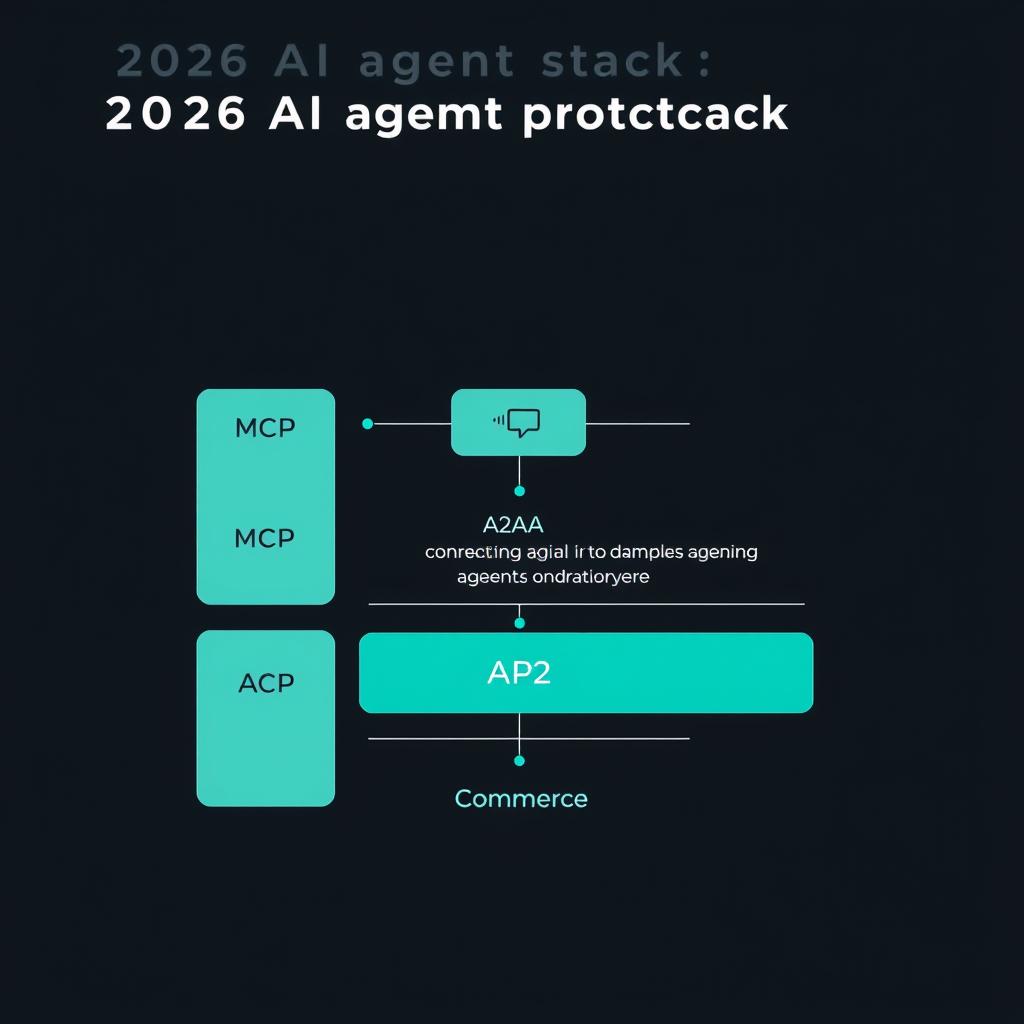
The agent protocol ecosystem in 2026 resolves cleanly into three layers MCP Hits 97M Downloads:
| Layer | Protocol | Purpose | Creator | Adoption |
|---|---|---|---|---|
| Tool Access | MCP | Agent → database, API, file system | Anthropic (Nov 2024) | 97M SDK downloads/mo, 5,800+ servers |
| Agent Coordination | A2A | Agent ↔ Agent discovery, delegation, negotiation | Google (Apr 2025) | 150+ orgs, Linux Foundation |
| Commerce | AP2 | Agent ↔ Agent payments, transactions | Google + Coinbase (Sep 2025) | Formal A2A extension |
Each layer solves a different problem. MCP is the “USB-C for tools” — any agent can plug into any MCP server. A2A is the “HTTP for agents” — agents discover each other, negotiate tasks, and hand off complex workflows. AP2 extends A2A with payment primitives.
Google’s own metaphor captures it: “A2A is the horizontal bus; MCP is the vertical bus.” A2A Protocol Explained — 150+ Organizations
MCP: The Tool Access Layer
MCP hit 97 million monthly SDK downloads in March 2026, up from ~2 million at launch — a 4,750% growth in 16 months MCP Hits 97M Downloads. Adoption from every major provider (Anthropic, OpenAI, Google DeepMind, Microsoft, AWS) makes it the de facto standard.
Architecture
A production MCP deployment splits into three roles:
Agent Runtime (Claude/GPT/Gemini)
  → MCP Client (built into SDK)
    → Transport (stdio for local, HTTP+SSE for remote)
      → MCP Server → Tools, Resources, Prompts
The wire format is JSON-RPC 2.0 MCP Hits 97M Downloads. A minimal server in Python:
from mcp.server import Server
from mcp.server.transport.http import HttpTransport

app = Server("analytics-server")

@app.tool()
async def query_analytics(metric: str, date_range: str) -> dict:
    """Query production analytics data."""
    # In production: authenticate, rate-limit, query warehouse
    return {"metric": metric, "value": 8472, "unit": "requests/s"}

if __name__ == "__main__":
    transport = HttpTransport(host="0.0.0.0", port=8000)
    app.run(transport)
What MCP Does Not Do
MCP is agent-to-tool only. It does not handle AI Agent Protocols 2026 Complete Guide:
- Agent-to-agent task delegation
- Capability discovery between agents
- Long-running stateful workflows
- Cross-vendor agent coordination
These gaps are deliberate — they fall to A2A.
A2A: The Agent Coordination Layer
Google launched A2A at Cloud Next 2025 with 50+ partners including Atlassian, Cohere, MongoDB, PayPal, Salesforce, SAP, and ServiceNow AI Agent Protocols 2026 Complete Guide. By April 2026, that number had tripled to 150+ organizations A2A Protocol Explained — 150+ Organizations. Google donated it to the Linux Foundation in June 2025, where it now shares governance with MCP under the same foundation.
Core Concepts
Four primitives drive every A2A interaction A2A Protocol Explained — 150+ Organizations:
- Agent Card — JSON document at
/.well-known/agent-card.jsondescribing capabilities, auth, endpoint, skills. RFC 8615 discovery. - Task — Explicit lifecycle: submitted → working → input-required → completed / failed / canceled. First-class long-running operations.
- Message — Unit of exchange within a Task. Roles:
"user"or"agent". Body as array of Parts (text, binary, structured data). - Artifact — Task output (JSON, PDF, image, structured data).
Agent Card Example
{
  "name": "code-review-agent",
  "version": "1.0.0",
  "capabilities": {
    "skills": ["code_review", "security_audit", "dependency_check"],
    "languages": ["python", "typescript", "rust"]
  },
  "authentication": {
    "schemes": ["oauth2", "api_key"]
  },
  "endpoints": {
    "send_message": "https://reviews.internal/a2a/send",
    "streaming": "https://reviews.internal/a2a/stream"
  }
}
How A2A and MCP Compose
A repair agent uses A2A to collaborate with diagnostic, estimate, and parts-procurement agents. Each specialist uses MCP to reach its own systems A2A Protocol Explained — 150+ Organizations:
Repair Agent (Orchestrator)
  via A2A → Diagnostic Agent (MCP: sensors DB, error catalog)
  via A2A → Estimate Agent (MCP: pricing DB, labor rates)
  via A2A → Parts Agent (MCP: inventory API, supplier DB)
          → (optionally AP2 for payment to supplier agents)
Each specialist agent is an MCP client internally, but an A2A peer externally. This composition is the production pattern that emerged through 2026 MCP Hits 97M DownloadsAI Agent Protocols 2026 Complete Guide.
Production Deployment Patterns
Pattern 1: Gateway-Backed MCP
For deployments where security and rate limiting matter (which is all production deployments), put MCP servers behind a gateway:
Agent → API Gateway (auth, rate-limit, audit) → MCP Server Pool
                                                ├─ Database MCP
                                                ├─ Analytics MCP
                                                └─ CRM MCP
Most teams using MCP in production report 60-70% reduction in integration time compared to custom per-tool connectors MCP Hits 97M Downloads.
Pattern 2: A2A Agent Registry
Maintain a service registry of internal Agent Cards. New agents register themselves; existing agents discover them dynamically:
AGENT_REGISTRY = {
    "code-review": {
        "card_url": "https://reviews.internal/.well-known/agent-card.json",
        "trust_level": "high"
    },
    "deploy-agent": {
        "card_url": "https://deploy.internal/.well-known/agent-card.json",
        "trust_level": "critical"
    }
}
A2A v1.0 introduced Signed Agent Cards — cryptographic signatures that verify card issuer identity and prevent forgery attacks against the registry A2A Protocol Explained — 150+ Organizations.
Pattern 3: Two-Protocol Agent
Every production agent in a multi-agent system should implement both protocols:
class ProductionAgent:
    """An agent that speaks both MCP and A2A."""

    def __init__(self):
        # MCP: connect to tools
        self.mcp_client = MCPClient()
        self.mcp_client.connect("postgres-mcp.internal:8000")
        self.mcp_client.connect("analytics-mcp.internal:8000")

        # A2A: announce to peers
        self.a2a_server = A2AServer(
            agent_card=AgentCard(
                name="analytics-agent",
                skills=["query", "aggregate", "forecast"]
            )
        )

    async def handle_a2a_task(self, task: Task):
        # Delegated by another agent via A2A
        # Fulfilled using MCP tools
        data = await self.mcp_client.call_tool(
            "query_analytics",
            {"metric": task.params["metric"]}
        )
        return Artifact(type="json", content=data)
Decision Framework
Not every project needs both protocols. Use this guide AI Agent Protocols 2026 Complete Guide:
| Use Case | Recommend |
|---|---|
| Single agent, multiple tools | MCP only |
| Multi-agent, same framework | MCP + same-framework glue |
| Multi-agent, different frameworks | MCP + A2A |
| Cross-org agent collaboration | MCP + A2A mandatory |
| Agent-to-agent payments | MCP + A2A + AP2 |
The most common mistake in 2026 production deployments is choosing MCP for everything when A2A handles the coordination problem better — or choosing A2A for everything when MCP handles tool access more cleanly. They were designed for different layers of the stack A2A Protocol Explained — 150+ Organizations.
What’s Next
A2A v1.0 shipped signed agent cards, multi-tenancy, multi-protocol bindings (JSON-RPC + gRPC), and version negotiation — the enterprise blockers that kept early adopters from moving past pilots A2A Protocol Explained — 150+ Organizations. The W3C AI Agent Protocol Community Group is working toward official web standards for agent communication, with specifications expected through 2026-2027 AI Agent Protocols 2026 Complete Guide.
For builders starting today: ship MCP servers for every data source and tool your agents touch. Then add A2A agent cards when you need cross-agent coordination. The protocols have converged — the only thing left is to build on them.
Feature image: Agent protocol stack architecture diagram generated via FLUX.1-schnell.
MCP Hits 97M Downloads MCP Hits 97M Downloads: https://www.digitalapplied.com/blog/mcp-97-million-downloads-model-context-protocol-mainstream AI Agent Protocols 2026 Complete Guide AI Agent Protocols 2026 Complete Guide: https://www.ruh.ai/blogs/ai-agent-protocols-2026-complete-guide A2A Protocol Explained — 150+ Organizations A2A Protocol Explained — 150+ Organizations: https://stellagent.ai/insights/a2a-protocol-google-agent-to-agent
← Back to all posts